Financial services organizations face unique challenges when deploying AI agents. Regulatory requirements from SEC, FINRA, and global bodies like MiFID II demand explainability, audit trails, and strict data governance. This guide explores proven architectures for deploying AI agents in banking, trading, and wealth management.
The Regulatory Landscape
Financial AI deployments must navigate:
- SEC/FINRA Requirements: Explainability for algorithmic trading decisions
- GDPR/CCPA: Customer data protection in AI-powered services
- Basel III/IV: Risk model validation and governance
- SOX Compliance: Audit trails for AI-assisted financial reporting
Reference Architecture: Trading Assistant Agent
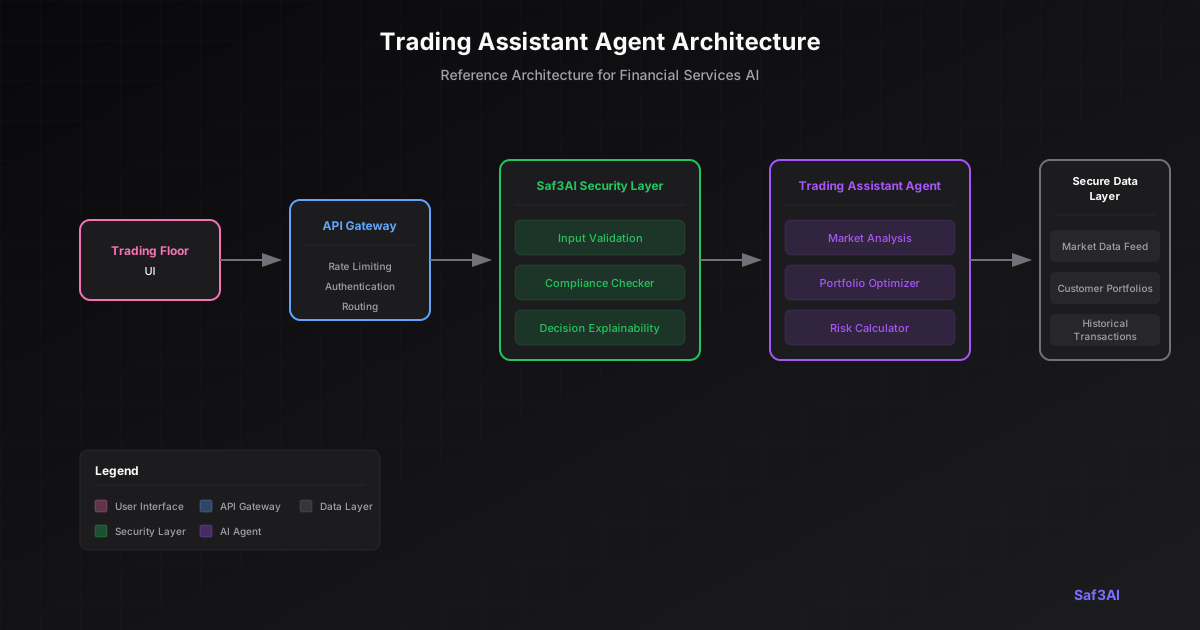
Key Security Controls
1. Decision Audit Trail
Every AI-assisted trading recommendation must be logged with:
- Input data snapshot
- Model version and parameters
- Reasoning chain (for explainability)
- Human override decisions
- Timestamp and user context
2. Chinese Wall Enforcement
AI agents must respect information barriers:
class ChineseWallEnforcer:
    def check_access(self, user_role, data_category):
        barriers = self.get_active_barriers()
        if self.would_breach_barrier(user_role, data_category, barriers):
            raise ComplianceViolation("Information barrier breach detected")
        return True
3. Real-time Compliance Monitoring
Saf3AI provides continuous monitoring for:
- Position Limits: Alerts when AI recommendations approach limits
- Restricted Lists: Blocks recommendations for restricted securities
- Trading Windows: Enforces blackout periods automatically
Customer Service Agent Architecture
For customer-facing AI agents in banking:
Customer Query → Intent Classification → PII Detection →
Compliance Check → Response Generation → Human Review Queue →
Response Delivery
Data Protection Requirements
- All customer PII must be tokenized before reaching the LLM
- Responses are scanned for accidental data leakage
- Conversation logs are encrypted and retained per regulatory requirements
Risk Assessment Agent
AI agents assisting with credit decisions require:
- Model Cards: Documented model behavior and limitations
- Bias Testing: Regular fairness audits across protected classes
- Adverse Action Explanations: Clear reasoning for denials
- Human-in-the-Loop: Mandatory review for edge cases
Implementation Checklist
- Implement comprehensive audit logging
- Deploy explainability layer for all AI decisions
- Configure information barriers in Saf3AI
- Set up real-time compliance monitoring
- Establish model governance framework
- Create incident response procedures for AI failures
- Document all AI models with model cards
- Implement bias testing pipeline
Conclusion
Financial services AI deployments require a compliance-first approach. By implementing proper security controls, audit trails, and governance frameworks, organizations can leverage AI agents while meeting regulatory obligations. Saf3AI provides the observability and control layer needed to deploy AI agents confidently in regulated environments.