Law firms and corporate legal departments are embracing AI agents for document review, legal research, and contract analysis. However, the unique requirements of attorney-client privilege, work product doctrine, and professional ethics create challenges that require specialized security architectures.
Legal Industry Challenges
AI deployments in legal must address:
- Attorney-Client Privilege: Confidential communications must remain protected
- Work Product Doctrine: Legal analysis and strategy documents
- Ethical Rules: Model Rules of Professional Conduct compliance
- Conflicts of Interest: Information barriers between matters
- Data Residency: Client requirements for data location
Reference Architecture: Legal Research Agent
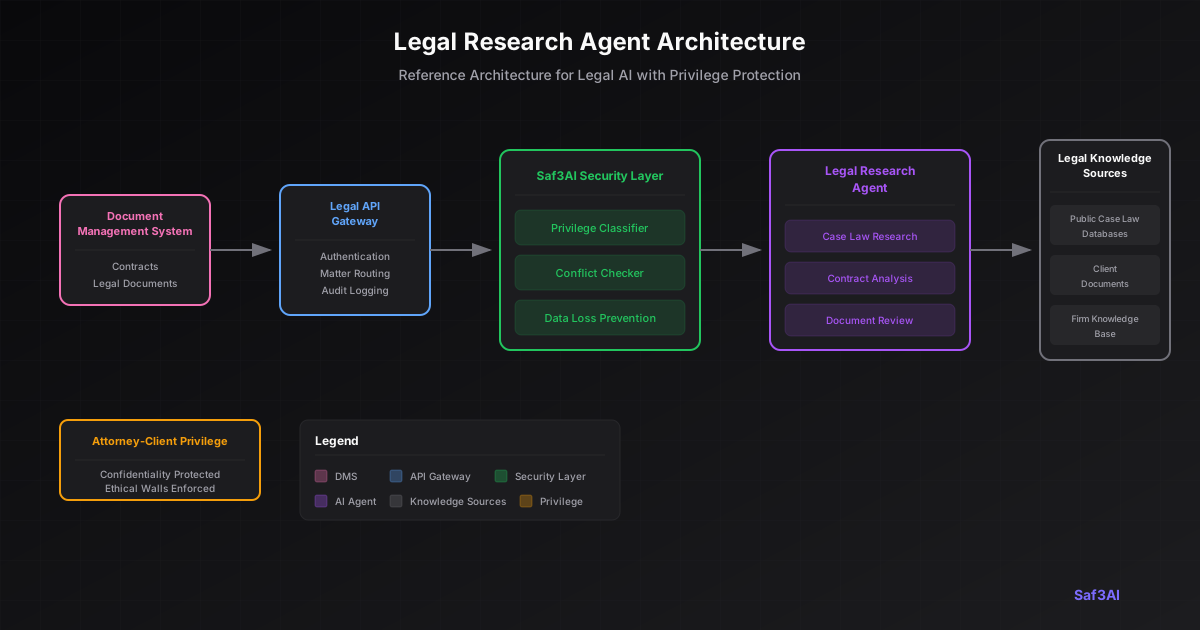
Privilege Protection
Classification System
All documents processed by AI agents must be classified:
class PrivilegeClassifier:
    CATEGORIES = [
        "ATTORNEY_CLIENT_PRIVILEGED",
        "WORK_PRODUCT",
        "CONFIDENTIAL_CLIENT",
        "PUBLIC_RECORD",
        "INTERNAL_ADMIN"
    ]

    def classify(self, document, metadata):
        # Check document metadata
        if metadata.get("privilege_marked"):
            return "ATTORNEY_CLIENT_PRIVILEGED"

        # Analyze content for privilege indicators
        score = self.analyze_content(document)

        # Apply conservative classification
        if score > 0.7:
            return "ATTORNEY_CLIENT_PRIVILEGED"

        return self.determine_category(document, metadata)
Privilege Log Generation
When documents are withheld or redacted:
Document ID → Privilege Category → Basis for Withholding →
Date Range → Author/Recipient → Subject Matter Description
Ethical Wall Enforcement
Matter-Based Access Control
| Team | Matter A | Matter B | Matter C |
|---|---|---|---|
| Team Alpha | ✗ Denied | ✗ Denied | ✓ Allowed |
| Team Beta | ✓ Allowed | ✓ Allowed | ✗ Denied |
| Team Gamma | ✓ Allowed | ✓ Allowed | ✓ Allowed |
AI agents must respect these barriers:
- Cannot cross-reference documents across walled matters
- Search results filtered by user’s matter access
- RAG retrieval scoped to permitted document sets
Contract Review Agent
For AI-assisted contract analysis:
Architecture
Contract Upload → Saf3AI Gateway → Privilege Check →
Clause Extraction → Risk Analysis → Redline Generation →
Attorney Review Queue → Client Delivery
Key Controls
- Clause Library Isolation: Client-specific clause libraries never mixed
- Playbook Enforcement: AI suggestions aligned with negotiation playbooks
- Risk Flagging: Automatic identification of non-standard terms
- Version Control: Complete audit trail of all AI suggestions
E-Discovery Agent
For litigation document review:
Processing Pipeline
Document Collection → Saf3AI Ingestion →
Privilege Review (AI-assisted) → Responsiveness Review →
Redaction Processing → Production Set Generation
Quality Controls
- Sampling: Random samples reviewed by attorneys
- Privilege Escalation: Uncertain documents flagged for human review
- Consistency Checking: AI decisions compared across similar documents
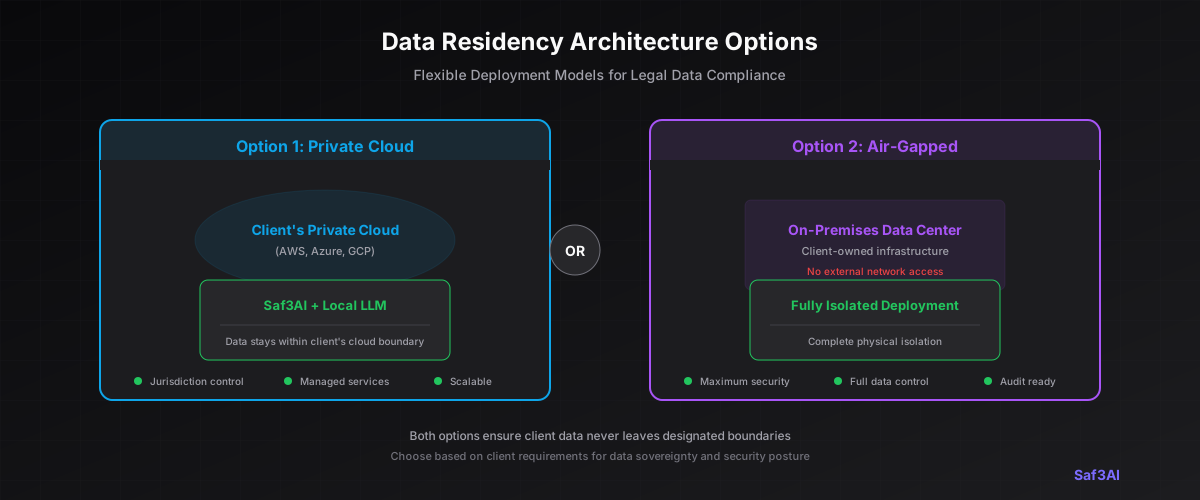
Data Residency and Security
Client-Specific Requirements
Many clients require:
- Data processed only in specific jurisdictions
- No data sent to external AI APIs
- On-premises or private cloud deployment
Architecture Options
Professional Responsibility
Competence (Rule 1.1)
Attorneys must understand AI limitations:
- AI suggestions require attorney review
- Final legal judgment remains with licensed attorneys
- Training on AI capabilities and risks
Supervision (Rules 5.1, 5.3)
Partners must ensure:
- AI outputs reviewed before client delivery
- Quality control processes documented
- Staff trained on proper AI use
Confidentiality (Rule 1.6)
Technical measures:
- Encryption in transit and at rest
- Access logging and monitoring
- Vendor agreements with confidentiality provisions
Implementation Checklist
- Implement privilege classification system
- Configure ethical walls per matter requirements
- Deploy data loss prevention controls
- Set up matter-based access control
- Create privilege review workflows
- Document AI use for ethical compliance
- Train attorneys on AI limitations
- Establish quality control sampling procedures
Conclusion
Legal AI deployments require careful attention to privilege, ethics, and confidentiality. By implementing proper classification systems, ethical walls, and oversight mechanisms, law firms can leverage AI agents while maintaining professional standards. Saf3AI provides the security and governance layer needed to deploy AI in the demanding legal environment.