Deploying AI agents in enterprise environments requires careful architectural planning. The deployment pattern you choose impacts security, compliance, performance, and operational complexity. This guide covers the most effective patterns for secure enterprise AI deployment.
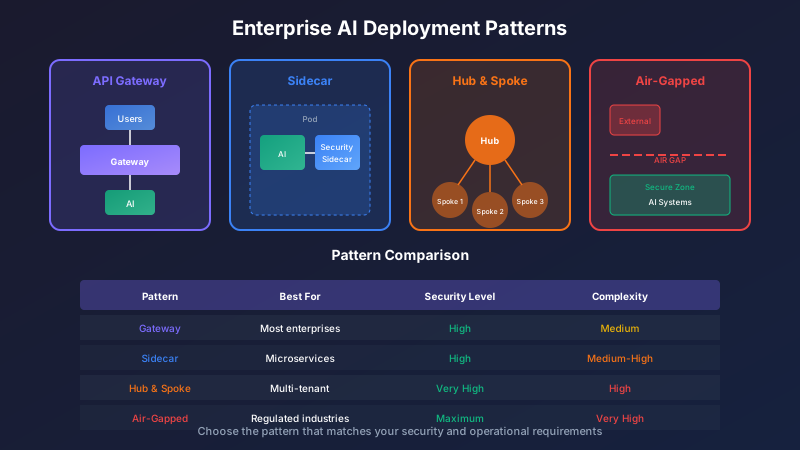
Deployment Pattern Overview
| Pattern | Best For | Security Level | Complexity |
|---|---|---|---|
| Gateway | Most enterprises | High | Medium |
| Sidecar | Microservices | High | Medium-High |
| Hub-and-Spoke | Multi-tenant | Very High | High |
| Air-Gapped | Regulated industries | Maximum | Very High |
Pattern 1: API Gateway Architecture
The most common and versatile pattern for enterprise AI deployment.
How It Works
All AI traffic flows through a central gateway that provides security controls:
Traffic Flow:
Users → Gateway → AI Service → Tools/Data
                ↓
         Security Controls
         - Authentication
         - Rate Limiting
         - Threat Detection
         - Logging
Benefits
| Benefit | Description |
|---|---|
| Centralized Control | All policies in one place |
| Visibility | Complete traffic observation |
| Flexibility | Easy to add/modify controls |
| Standards | Built on proven API gateway tech |
Implementation Considerations
Must Have:
- TLS termination and re-encryption
- Request/response inspection
- Authentication integration
- Comprehensive logging
Should Have:
- Caching for common requests
- Circuit breakers for resilience
- A/B testing capability
- Canary deployment support
When to Use
- Standard enterprise deployments
- Multi-application AI access
- Centralized security team
- Compliance requirements
Pattern 2: Sidecar Architecture
Security controls deployed alongside each AI service.
How It Works
Each AI service has its own security proxy:
Deployment Model:
[Pod/Container]
├── AI Service
└── Security Sidecar
    ├── Input validation
    ├── Output filtering
    ├── Local logging
    └── Policy enforcement
Benefits
| Benefit | Description |
|---|---|
| Isolation | Compromise doesn’t spread |
| Scale | Security scales with services |
| Latency | Local processing faster |
| Autonomy | Teams own their security |
Implementation Considerations
Must Have:
- Service mesh integration (Istio, Linkerd)
- Centralized policy distribution
- Consistent configuration
- Log aggregation
Should Have:
- Health checking
- Automatic updates
- Resource limits
- Failover handling
When to Use
- Kubernetes/container environments
- Microservices architectures
- Decentralized teams
- Low-latency requirements
Pattern 3: Hub-and-Spoke
Centralized control with distributed enforcement for multi-tenant environments.
How It Works
Central hub manages policy; spokes enforce locally:
Architecture:
           [Central Hub]
          /      |      \
    [Spoke A] [Spoke B] [Spoke C]
       |          |         |
    Tenant 1   Tenant 2   Tenant 3
Hub Responsibilities
- Policy definition and distribution
- Central logging aggregation
- Cross-tenant analytics
- Configuration management
Spoke Responsibilities
- Local policy enforcement
- Tenant-specific customization
- Edge processing
- Local caching
Benefits
| Benefit | Description |
|---|---|
| Multi-tenancy | Strong tenant isolation |
| Customization | Per-tenant policies |
| Resilience | Spokes operate independently |
| Compliance | Data stays in tenant boundary |
When to Use
- SaaS platforms
- Multi-subsidiary enterprises
- Regional compliance needs
- Franchise/partner models
Pattern 4: Air-Gapped Deployment
Maximum security for highly regulated environments.
How It Works
AI systems completely isolated from external networks:
Network Zones:
[Public Zone] ─┐
               │ (One-way data diode)
[DMZ]         ─┤
               │ (Controlled transfer)
[Secure Zone] ─┘
    └── AI Systems (isolated)
Requirements
Network Isolation:
- No direct internet connectivity
- Physical network separation
- Data diodes for one-way transfer
- Air-gapped model updates
Operational:
- Local model hosting
- On-premise infrastructure
- Manual update procedures
- Specialized staff
Benefits
| Benefit | Description |
|---|---|
| Maximum Security | No external attack surface |
| Data Sovereignty | Complete data control |
| Compliance | Meets strictest requirements |
| Isolation | Contained blast radius |
Challenges
| Challenge | Mitigation |
|---|---|
| Model updates | Scheduled, verified update procedures |
| Feature lag | Accept trade-off for security |
| Operational cost | Automate where possible |
| Staff expertise | Specialized training |
When to Use
- Defense and intelligence
- Critical infrastructure
- Highly regulated industries
- Extreme compliance requirements
Hybrid Patterns
Many enterprises combine patterns for different use cases:
Pattern: Gateway + Air-Gapped
Configuration:
- Gateway for general AI workloads
- Air-gapped for sensitive data processing
- Controlled data transfer between zones
Use Case: Healthcare organization with PHI processing needs
Pattern: Hub-and-Spoke + Sidecar
Configuration:
- Hub-and-spoke for multi-tenant structure
- Sidecars for service-level controls
- Combined policy enforcement
Use Case: Large SaaS platform with microservices
Security Control Placement
Where to implement specific controls:
| Control | Gateway | Sidecar | Hub | Spoke |
|---|---|---|---|---|
| Authentication | ✓ | ✓ | ||
| Rate Limiting | ✓ | ✓ | ✓ | |
| Threat Detection | ✓ | ✓ | ✓ | ✓ |
| Policy Enforcement | ✓ | ✓ | ✓ | ✓ |
| Logging | ✓ | ✓ | ✓ | ✓ |
| PII Filtering | ✓ | ✓ |
Migration Considerations
When moving from one pattern to another:
Gateway → Hub-and-Spoke
Steps:
- Identify tenant boundaries
- Deploy spoke infrastructure
- Migrate tenants incrementally
- Establish hub governance
Monolith → Sidecar
Steps:
- Containerize AI services
- Deploy sidecars alongside
- Migrate traffic gradually
- Decommission legacy controls
Implementation Checklist
Pattern Selection
- Requirements documented
- Patterns evaluated
- Decision rationale recorded
- Stakeholder approval
Architecture
- Network design complete
- Security controls mapped
- Integration points identified
- Failure modes analyzed
Implementation
- Infrastructure provisioned
- Controls deployed
- Testing completed
- Documentation updated
Operations
- Monitoring configured
- Alerting enabled
- Runbooks created
- Team trained
Key Takeaways
- Choose pattern for your context - No one-size-fits-all solution
- Layer your controls - Defense in depth applies to deployment too
- Plan for growth - Select patterns that scale with you
- Consider operations - Complexity has ongoing costs
- Stay flexible - Hybrid patterns often work best
The right deployment pattern is foundational to AI security. Choose wisely.
Planning your AI deployment architecture? Schedule a demo to see how Saf3AI fits into your pattern.