Multi-agent systems—where multiple AI agents collaborate to complete complex tasks—are becoming increasingly common. But with collaboration comes new attack surfaces. When agents can delegate tasks to each other, how do you prevent a compromised agent from poisoning the entire system?
The Multi-Agent Landscape
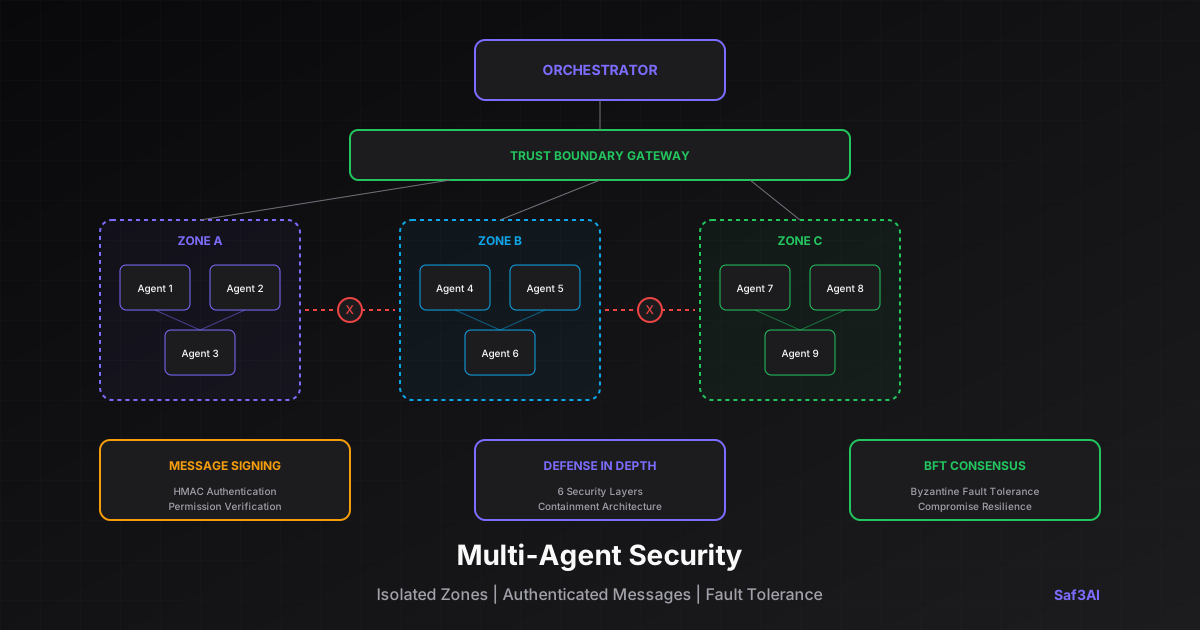
Different multi-agent architectures have different security implications:
| Pattern | Description | Security Considerations |
|---|---|---|
| Hierarchical | Orchestrator controls worker agents | Single point of failure at orchestrator |
| Collaborative | Agents communicate peer-to-peer | Complex trust relationships |
| Pipeline | Sequential processing chain | Injection can propagate downstream |
| Swarm | Consensus-based decisions | Vulnerable to majority manipulation |
Attack Vectors in Multi-Agent Systems
1. Delegation Chain Attacks
When agents can delegate tasks, attackers can exploit trust relationships:
Normal Flow: User → Agent A (Trusted) → Agent B (Trusted)
Attack Flow: Attacker injects prompt → Agent A (Confused) → Agent B (Executes malicious request)
The Problem: Agent B trusts Agent A, which is now compromised. The malicious instructions propagate through the trust chain.
2. Privilege Escalation
Agents may have different permission levels, creating escalation opportunities:
| Agent | Permission Level |
|---|---|
| Agent A | Read-only (Low) |
| Agent B | Read/Write (Medium) |
| Agent C | Admin (High) |
Attack Scenario:
- Attacker compromises low-privilege Agent A
- Agent A makes legitimate-looking request to Agent B
- Agent B relays request to Agent C
- Agent C executes admin action
Result: Low-privilege agent achieved admin action through trust chain.
3. Consensus Manipulation
In swarm systems with majority voting, attackers can influence group decisions:
Legitimate Consensus (5 agents):
- Agents A, B, D vote YES
- Agents C, E vote NO
- Decision: YES (3-2)
Attack (Compromise 2 agents):
- Agents A, B compromised → vote NO
- Agents C, E vote NO
- Agent D votes YES
- Decision: NO (1-4)
Key Insight: Attackers only need to compromise a minority of agents to flip decisions.
Security Architecture for Multi-Agent Systems
Trust Boundary Enforcement
Organize agents into isolated zones with controlled communication:
External Zone (Untrusted)
- All user input enters here
- Maximum validation applied
Trust Boundary Gateway
- Input validation
- Threat detection
- Rate limiting
- Session management
Orchestration Zone (Conditionally Trusted)
- Orchestrator validates all inter-agent messages
- Enforces permission boundaries
- Monitors for anomalies
Agent Zones (Trusted)
- Isolated from each other
- Cross-zone communication requires gateway validation
- Separate credentials per zone
Message Authentication
Every inter-agent message should be authenticated and verified:
Message Structure:
{
  "message_id": "uuid",
  "timestamp": "ISO8601",
  "sender": "agent_a",
  "receiver": "agent_b",
  "action": "delegate_task",
  "payload": { ... },
  "permissions_claimed": ["read_data"],
  "trace_id": "request_trace",
  "signature": "HMAC(message, agent_key)"
}
Verification Steps:
- Verify signature matches sender
- Check timestamp is recent (prevent replay)
- Validate sender has claimed permissions
- Verify action is allowed between these agents
- Check rate limits not exceeded
- Log message for audit trail
Defense-in-Depth for Multi-Agent
Layer 1: Input Validation Validate all inputs before they reach any agent.
- Content filtering
- Format validation
- Threat detection
- Length limits
Layer 2: Agent Isolation Each agent runs in isolated environment.
- Sandboxed execution
- Limited network access
- No shared memory
- Separate credentials
Layer 3: Communication Security Secure all inter-agent communication.
- Message signing
- Encryption in transit
- Schema validation
- Permission verification
Layer 4: Action Authorization Verify every action against policy.
- Role-based access
- Context-aware rules
- Human approval for high-risk
- Rate limiting
Layer 5: Output Validation Validate all outputs before delivery.
- PII detection
- Policy compliance
- Content safety
- Format verification
Layer 6: Continuous Monitoring Monitor all agent behavior in real-time.
- Anomaly detection
- Threat correlation
- Performance metrics
- Audit logging
Byzantine Fault Tolerance
For critical decisions, implement Byzantine Fault Tolerance (BFT):
Traditional Voting: 51% majority = consensus BFT Requirement: (2f + 1) agreeing nodes, where f = faulty agents
Example: 7 agents, can tolerate 2 compromised
Even if 2 agents are compromised and voting maliciously:
- 5 honest agents > 2f + 1 (5) requirement ✓
BFT Consensus Process:
- Each agent proposes its decision
- Agents broadcast proposals to all others
- Each agent collects 2f + 1 matching proposals
- Agents vote on collected proposals
- Decision requires 2f + 1 identical votes
- Result is cryptographically committed
Implementation Checklist
Zone Architecture
- Agents organized into security zones
- Trust boundary gateway implemented
- Cross-zone traffic validated
- Orchestrator enforces boundaries
Message Security
- All messages signed
- Timestamps verified
- Permissions validated
- Rate limits enforced
Agent Isolation
- Sandboxed execution
- Separate credentials
- Limited network access
- No shared storage
Consensus Protection
- BFT for critical decisions
- Quorum requirements defined
- Vote verification
- Decision auditing
Monitoring
- Inter-agent traffic logged
- Anomaly detection enabled
- Alert thresholds set
- Incident response tested
Key Takeaways
- Trust no single agent - Compromise of one shouldn’t compromise all
- Authenticate everything - All inter-agent communication must be verified
- Implement isolation - Agents should run in separate security contexts
- Use consensus carefully - Consider Byzantine fault tolerance for critical decisions
- Monitor continuously - Detect anomalies in agent collaboration patterns
Multi-agent systems multiply both capabilities and risks. Security must be designed in from the start, not bolted on later.
Building a multi-agent system? Schedule a demo to learn how Saf3AI can help secure your agent collaboration.