The traditional security model of “trust but verify” doesn’t work for AI agents. These systems can be manipulated through prompt injection, social engineering, and other novel attack vectors. Zero trust architecture—where nothing is trusted by default—provides a more robust security foundation.
Why Zero Trust for AI?
AI agents operate in a fundamentally different way than traditional software:
Traditional Software vs AI Agents
| Characteristic | Traditional Software | AI Agents |
|---|---|---|
| Behavior | Deterministic | Non-deterministic |
| Trust boundaries | Clear | Blurred |
| Attack surface | Well-defined | Dynamic |
| Failure modes | Known | Emergent |
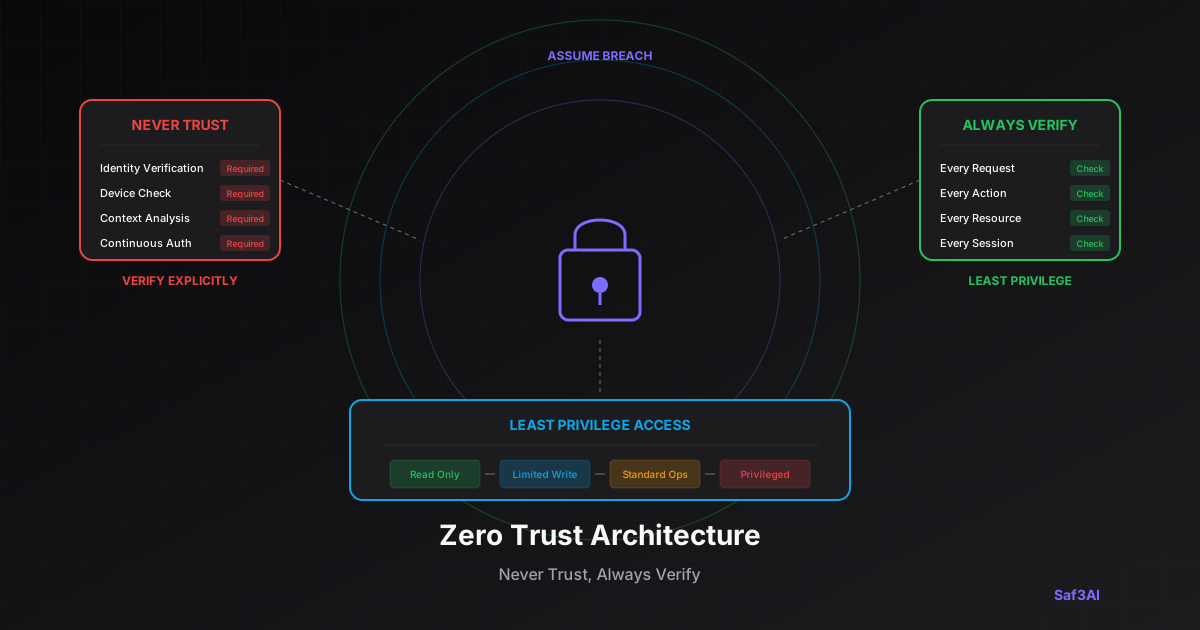
The Three Principles of Zero Trust
1. Never Trust (Verify Explicitly)
Every request must be authenticated and authorized, regardless of source.
Verification Requirements:
- Identity Check - Validate user/service identity
- Device Check - Verify device trust status
- Context Check - Analyze location, time, behavior
- Continuous Auth - Re-verify throughout session
Decision Outcomes:
- Allow (all checks pass)
- Require MFA (elevated risk)
- Deny (policy violation)
2. Least Privilege Access
AI agents should have the minimum permissions required for each task:
| Tier | Operations | Risk Level |
|---|---|---|
| Tier 0 | Read-only (search, lookup) | Low |
| Tier 1 | Limited write (drafts, preferences) | Low-Medium |
| Tier 2 | Standard operations (notifications, updates) | Medium |
| Tier 3 | Privileged (financial, delete, permissions) | High - Requires human approval |
Key Principle: Each agent is assigned to a specific tier based on its use case and risk profile. Elevation requires explicit authorization.
3. Assume Breach
Design systems with the assumption that the AI agent may be compromised:
Containment Layers:
-
Output Validation
- Check for data exfiltration attempts
- Validate response format
- Detect policy violations
-
Action Filtering
- Block unauthorized tool calls
- Rate limit operations
- Require approval for sensitive actions
-
Anomaly Detection
- Monitor for unusual patterns
- Compare to baseline behavior
- Alert on suspicious activity
Only validated, filtered actions reach protected resources.
Complete Zero Trust Architecture
A comprehensive zero trust deployment includes multiple security layers:
User Layer
All access points—human users, API clients, and service accounts—enter through the same verification process.
Identity & Access Management
- IdP Integration (SAML, OIDC, etc.)
- Policy Engine for authorization decisions
- Session Manager for lifecycle control
Input Security Layer
- Threat Detection for prompt injection
- Input Validation for format/content
- Rate Limiting per user/operation
Agent Runtime
- Sandboxed execution environment
- Limited system access
- No persistent storage
- Short-lived sessions
Tool Access Layer
- Tool Gateway validates all calls
- Parameter constraints enforced
- Per-tool rate limits
- Complete logging
Output Security Layer
- Output Validation before delivery
- PII Filtering for sensitive data
- Policy Compliance checks
Monitoring & Response
- SIEM Integration for correlation
- Alerting System for incidents
- Incident Response automation
Micro-Segmentation for AI Tools
Apply micro-segmentation to limit blast radius if a tool is compromised:
Segment A: Read-Only Tools
- Search, Calendar, Weather
- No cross-segment access
- Isolated network
Segment B: Customer Data
- CRM Read, Ticket Updates
- Isolated from internal tools
- Audit all access
Segment C: Internal Tools
- Slack, Jira, Wiki
- Isolated from customer data
- Separate credentials
Key Benefit: Compromise of one segment cannot spread to others.
Continuous Verification Loop
Trust is continuously evaluated, not just at initial authentication:
VERIFY → EVALUATE → ENFORCE → MONITOR → VERIFY...- Verify - Identity, context, behavior, request
- Evaluate - Calculate risk score, compare to baseline
- Enforce - Allow, restrict, block, or alert
- Monitor - Log events, detect anomalies, update baselines
Every action triggers re-evaluation of trust level.
Implementation Checklist
Identity & Access
- SSO integration configured
- MFA required for all users
- Service accounts with minimal permissions
- API key rotation policy
Network Segmentation
- Agents in isolated network segments
- Tools grouped by sensitivity
- Cross-segment traffic blocked
- Egress filtering enabled
Runtime Security
- Sandboxed execution environment
- Resource limits configured
- Session timeouts enforced
- No persistent storage access
Monitoring
- All actions logged
- Behavioral baselines established
- Anomaly detection enabled
- Alert thresholds configured
Incident Response
- Automated containment actions
- Escalation procedures defined
- Forensic logging enabled
- Recovery procedures tested
Key Takeaways
- Never trust input - All user input and external data may be malicious
- Verify every action - Authenticate and authorize each operation
- Minimize privileges - Give agents only the access they absolutely need
- Assume compromise - Design systems to limit damage when breaches occur
- Monitor continuously - Trust must be continuously re-evaluated
Zero trust isn’t just a security framework—it’s a mindset that should inform every aspect of AI agent design and deployment.
Ready to implement zero trust for your AI agents? Schedule a demo to see how Saf3AI can help.