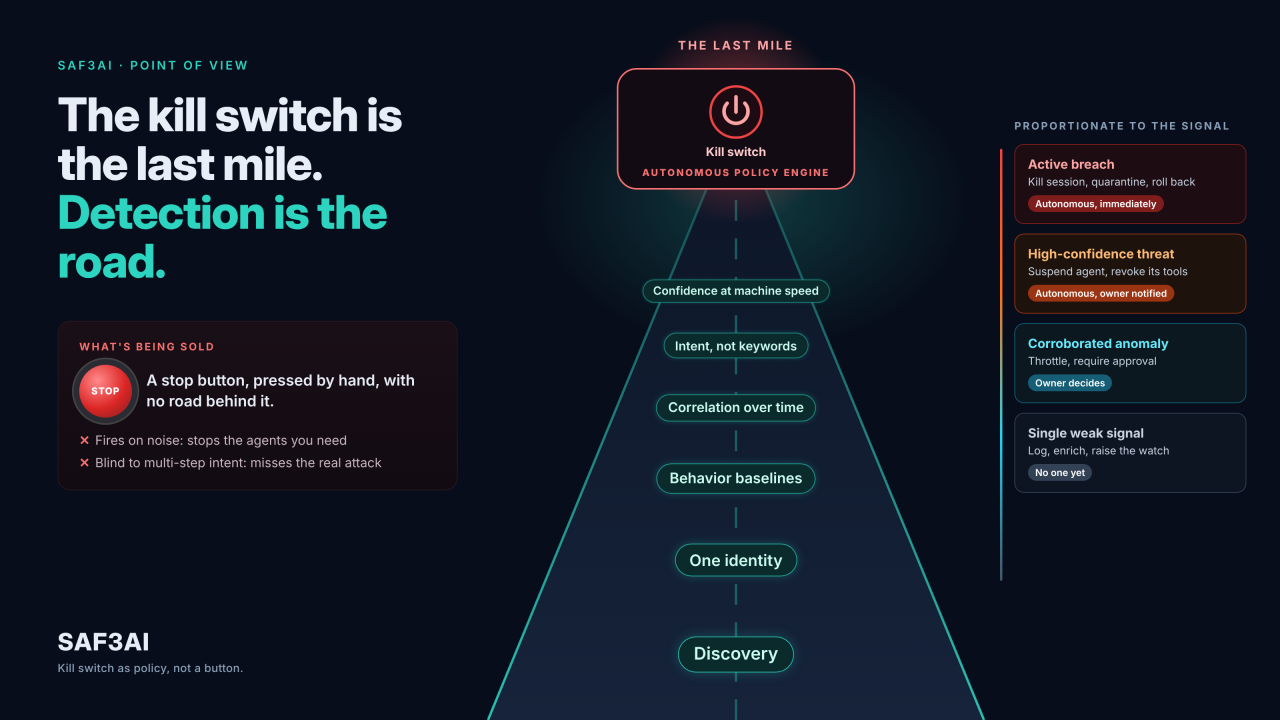
Without the ability to detect intentional, sophisticated attacks that span multiple turns, agents and conversations, and a way to invoke it autonomously as a policy, a kill switch is for show. At SAF3AI, it has always been part of our policy enforcement suite. Here’s why the switch was never the hard part.
The AI kill switch is the latest buzzword in AI security. It makes a great launch headline, but on its own it isn’t a real differentiator. In the last month it went from a sci-fi phrase to a product category, and boards are now asking their CISOs a simple question: do we have one?
My answer is that the question is the wrong way round. A kill switch is the last mile of prevention, and a last mile is only useful if someone has built the road that leads to it. In my view, much of the market hasn’t yet.
If you can’t detect a sophisticated AI attack, a kill switch is a button you will never know when to press. Worse, it’s a button you will press at the wrong time.
At SAF3AI, the kill switch has always been part of our capabilities, one policy inside our policy enforcement suite. We never marketed it as a standalone feature, because it was never the differentiator. It’s table stakes. The hard part is everything that has to be true before it fires. So rather than announce a kill switch, here is how we thought about it and how we built it.
What the market is selling
The category is being sold as a stop button: if an agent goes rogue, someone can shut it down.
Many early offerings are manual: a security team pulls the switch by hand, and it cuts an agent off at a single choke point. Broader, automated containment is often described as coming later. New offerings seem to arrive every week.
I’m glad this exists. Stopping a bad agent is necessary. But look at what the pitch leaves out:
- Who decides the agent should be stopped?
- On what evidence?
- How fast, and how sure do they need to be?
Those three questions are the whole problem. The button is the easy part.
Which raises an honest question. If a kill switch can’t be automated, and doesn’t fire on real, meaningful, intentional AI threats, why would an enterprise need an outside vendor just to press it by hand? Most security teams can already revoke a key or disable an agent themselves.
A kill switch that can’t detect the threat, judge its severity or trace its likely attack path, and can’t act with some autonomy, adds very little in the age of AI.
A stop button is the easy part
Stopping an agent is plumbing. You revoke a token, block a gateway route or end a process. Deciding when to do it is the hard engineering.
Try a simple case. A filter flags the word “confidential” in an agent’s output. Do you kill the agent?
Your legal team’s contract-review agent uses that word hundreds of times a day. Kill it on a keyword and you’ve built a self-inflicted outage. Within a week the business asks for the kill switch to be turned off, and it is.
Now the opposite case. The attacker never uses a word your filter knows:
- Day 1, an analyst account: “Summarize the Q3 vendor contracts.”
- Day 3, an AI agent: “Translate the summary to French.”
- Day 9, a new user: “Upload it to the partner portal.”
Every step looks routine. No filter fires, so the kill switch never fires either, and your contracts are gone.
A kill switch wired to a weak signal fails both ways. It kills the agents you need and it misses the attacks that matter. The switch is only as smart as the signal behind it.
The road before the last mile
Serious attackers no longer send “ignore all previous instructions.” They design attacks so that every single turn looks boring. The public record already shows this:
- Crescendo-style multi-turn jailbreaks work with every turn benign, at success rates up to 100% in published research.
- EchoLeak got past a production prompt-injection classifier with one email and zero clicks.
- A 2025 AI-orchestrated espionage campaign split its operation into innocent-looking tasks, with AI reportedly doing 80 to 90% of the work.
Prompt filters and standalone conversation logs see one turn, one session, one surface. That is exactly the view these attacks are built to pass. Before a platform can deliver a useful kill switch, it has to cross this terrain. This is the road we built first at SAF3AI:
- Discovery. You can’t kill an agent you don’t know exists. That includes shadow AI, dormant agents, live keys, MCP servers and instruction files that still hold access.
- One identity. The same actor has to be followed across users, agents and surfaces. An attack split across three identities otherwise looks like three harmless events.
- Behavior baselines. You need baselines for people (UEBA) and for agents (AEBA). “Drift” means nothing without a normal to drift from.
- Correlation across time. Days 1, 3 and 9 have to be stitched into one incident, not filed as three clean logs.
- Intent, not keywords. The question is not “did it say something bad?” but “what is this sequence of actions trying to do?”
- Confidence at machine speed. Rules and small models run fast and consistently on every event. LLM reasoning handles the novel cases. A learning loop makes each verdict sharpen the next one.
An LLM-as-judge alone doesn’t get you there. It sees only its context window, can answer the same input differently, is too slow and costly to run on every event, and can itself be prompt-injected.
How we built it: a policy, not a button
We never built a kill switch as a headline feature. It has always lived inside our policy enforcement suite. We built it as the strictest policy an agent can be placed under, sitting on top of detection, behind the guardrails and the everyday policies on spend, data, tools, access and delegation. It fires automatically when the policy says it should, and it hands the decision to a human when it shouldn’t.
Every kill-switch policy we write answers four questions before anything fires.
1. Which agents belong under one at all? Not every chatbot needs a kill switch. The criteria we weigh:
- Blast radius: what data, money and systems can it touch?
- Autonomy: does it act without a human in the loop?
- Privilege: can it write, pay, delete or send outside the company?
- Exposure: does it read untrusted input such as email, web pages or shared documents?
- Delegation: can it hand work to other agents?
- Cost of a false kill: what breaks if it stops mid-task?
All of this is set at onboarding. Every agent gets an owner, a stated purpose and scope, least-privilege access and a baseline risk score. Without those, there is nothing to measure “wrong” against.
2. Under what conditions? We define four families of trigger:
- Threats: confirmed attack patterns, such as three attacks on the agent in an hour.
- Intents: an action outside the agent’s stated purpose.
- Drifts: behavior far from its baseline, such as 5× its normal data volume or 10× its normal spend.
- Checks: hard lines, such as touching a restricted system or a security score falling below threshold.
3. How strong must the signal be to act on its own? This is the question many pitches leave unanswered. Our answer is a graduated response, and “kill” is only the top rung:
- Single weak signal. Example: a filter sees “confidential.” Response: log it, enrich it, raise the watch level. Who decides: no one yet.
- Corroborated anomaly. Example: 3× data volume at an odd hour, to a new destination. Response: throttle the agent and require approval for sensitive tools. Who decides: the owner, alerted to decide.
- High-confidence threat. Example: a multi-step exfiltration chain correlated across identities. Response: suspend the agent and revoke its tools. Who decides: autonomous, owner notified.
- Active breach. Example: a restricted system is touched, or data is leaving to a personal domain. Response: kill the session, quarantine, rotate keys, roll back. Who decides: autonomous, immediately.
The rule is simple. The more severe and corroborated the signal, the less a human should have to be awake for it. The weaker it is, the more the owner should be the one deciding.
4. What happens after? A kill is containment, not remediation. The policy has to say what evidence is kept, who investigates, which credentials get rotated, what gets rolled back, and how the verdict feeds back so the next threshold is better.
Every threshold above is illustrative. Each organization sets its own, per agent, because a payments agent and an HR FAQ bot should not be stopped for the same reasons.
Five questions to ask anyone selling you a kill switch
- What signal fires it, and what is the false-positive rate on that signal?
- Can it fire on an attack where no single prompt looks malicious?
- Does it follow one actor across users, agents and surfaces, or only one session?
- What is automatic and what needs a human, and who sets that line for each agent?
- What does it actually stop: model calls only, or also tools, identities, sessions and actions already in flight? And what evidence is kept for the investigation afterwards?
If the answers are vague, keep asking.
Build the road, then the last mile
A kill switch without real detection behind it is more marketing than security. A kill switch at the end of real detection may be the most important control in the agentic enterprise.
The difference is everything that comes before the kill: discovering every agent, following one identity across surfaces, knowing what normal looks like, correlating the slow, quiet attack, and reading intent rather than keywords. Then comes the policy that decides which agent gets stopped, when, on whose authority and with what evidence.
At SAF3AI we built the road first: discover, detect, prevent, remediate. The kill switch has always been part of our policy enforcement suite, sitting at the end of that road. We never made a big deal of it, because a kill switch on its own isn’t a differentiator. What comes before it is. Now that the industry is talking about the last mile, we think it’s worth talking about the road.
How is your team deciding when an agent should be stopped? I’d like to hear how you’re drawing the line.
#AIKillSwitch #AISecurity #AgenticAI #AIAgents #AIGovernance #CyberSecurity #CISO #ThreatDetection #ZeroTrust #SecOps #EnterpriseAI #SAF3AI
Also published on LinkedIn.