Platform
Connectors are a checklist. The graph is the product.
A list of findings tells you what is wrong. A graph tells you what is reachable. Every SAF3AI connector writes into one Context Graph, so risk is scored by what an attacker can actually walk to — not by how alarming an individual alert sounded.
Capabilities
Key Features
One graph for every surface
Agents, models, tools, datastores, identities, prompts and findings from all twenty connectors resolve into the same graph — which is what lets a Copilot signal and a Claude signal about one person be one story.
Attack paths, computed
Not a diagram someone drew. The path from an external entry point through an agent and its tools to a sensitive datastore is derived from the relationships actually present in your estate.
Toxic combinations
Externally-reachable agent, write-capable tool, sensitive datastore. Individually unremarkable, together critical. The graph surfaces the combination as one finding rather than three mediums.
Reachability-based priority
A critical finding on something nothing can reach outranks nothing. Scoring is driven by what an attacker can actually walk to, which is what makes the top of the list worth working.
Counterfactual remediation
Every path comes with the change that collapses it — revoke this scope, and here is the new score. The fix is a specific action, not a severity label.
Compounding coverage
One module shows your slice of the graph. Each surface you add contributes entities and edges, so paths that were invisible become visible without any migration.
In the product
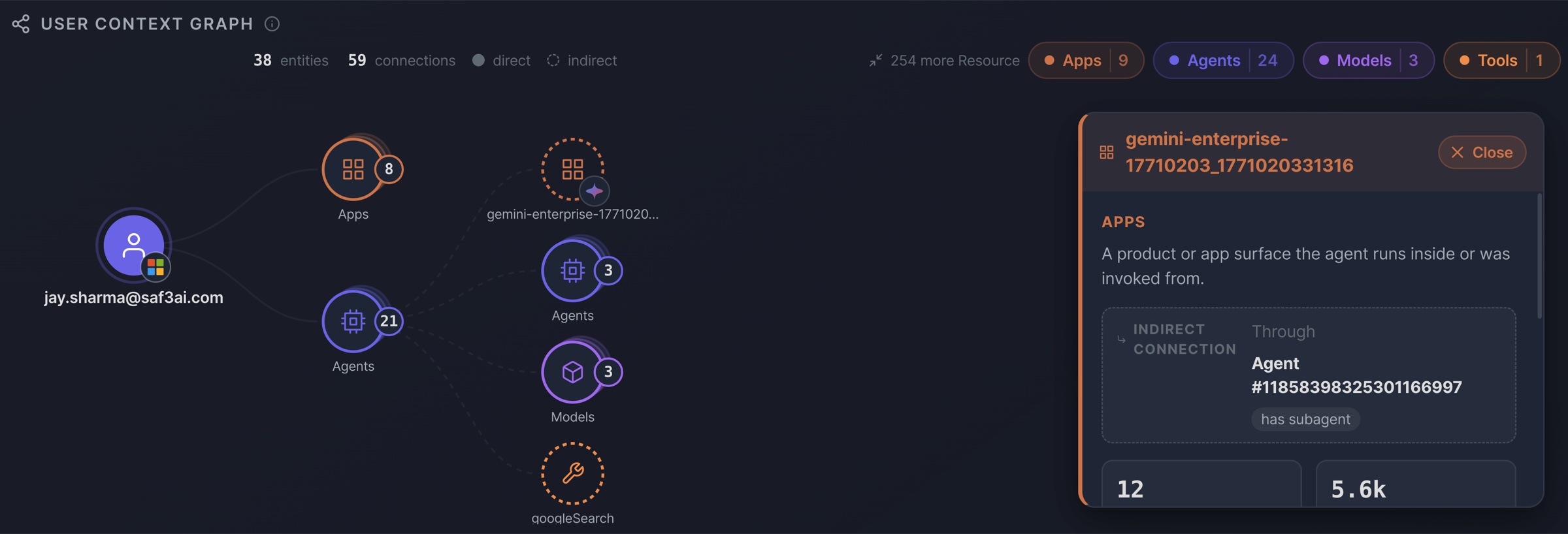
Entities, and the edges between them
Relationships are typed, not inferred. Invoked, Uses Model and Calls are different edges with different security meaning — which is what makes reachability computable rather than guessed.
Why a graph
Three mediums are not one critical
Flat scanners score findings independently, which means the combination that actually matters gets split across three tickets and three owners, and nobody sees the shape.
Without a graph
- MEDIUM Agent
ticket-triageis externally reachable - MEDIUM Tool
crm.writehas write scope - MEDIUM Datastore
customer_piiholds regulated data
Three tickets, three owners, three backlogs. Each one is defensible on its own and none of them gets worked.
With the graph
- CRITICAL 91
External prompt reaches
ticket-triage, which holdscrm.write, which readscustomer_pii
One path, one owner, one fix. Revoke crm.write and the score drops to 42.
The counterfactual tells you which change to make first.
What is in the graph
Entities and the edges between them
Agents
Custom agents, Copilot Studio agents, Gemini Enterprise agents, Bedrock and Vertex agents
Models
Every model reachable from your estate, hosted or API, with the provider behind it
Tools & MCP
What each agent can call, and whether the scope is read, write or execute
Datastores
Databases, vector stores, knowledge bases, buckets, Drive and SharePoint content
Identities
People, service accounts, API keys and agents, as one identity plane
Findings
Detections, scan results, code findings and exceptions attached to the entity they concern
One graph, one name. Everywhere in the product this is the Context Graph — the same substrate behind attack paths, AI-BOM, incident correlation and posture.
Get started with Context Graph
See how Saf3AI can help secure your AI agents.