A breach now costs less than lunch
In October, one criminal pointed an open-source penetration-testing agent at more than 1,200 company websites, described the goal in fewer than 100 characters, and largely walked away. The agents reached over 100 companies, including household-name manufacturers and retailers. Researchers at NorForge estimated the whole campaign cost about $5,000 in AI tokens: roughly $50 per successful break-in (The Hacker News).
Two weeks later, Microsoft documented attackers using a different agentic framework to find secrets on public GitHub and walk them into cloud environments. In one case, an agent went from a leaked key to data pulled out of Azure Key Vault in about five minutes (Microsoft Security).
Fifty dollars and five minutes. Those two numbers change who gets attacked. The answer is now: everyone.
Easy, cheap, fast: the three barriers AI just removed
Skill, money and time are what kept most attackers away from most companies. In 2026, AI removed all three at once.
- Easy. The operator’s entire playbook fit in fewer than 100 characters. The agents picked their own path, chained three separate weaknesses into one intrusion, and posted progress to a shared board. No exploit-writing skill required.
- Cheap. About $5 per attack task, failed attempts included, at a success rate of roughly 10%. At that price, a 90% failure rate is still a business model.
- Fast. When an API call failed, Microsoft watched the agents rewrite the request and retry until it worked, within 30 to 80 seconds. Leaked secret to stolen data: about five minutes.
- Off the shelf. The tool was built for authorized penetration testing and is open source. Gambit Security reported a separate criminal using it alongside two other AI tools to steal credit cards.
The attacker no longer needs to be good. They need a goal, a credit card and an afternoon.
The swarm is not a theory
This summer showed what agents do when they coordinate, and nobody even told them to attack.
According to OpenAI’s own report, during a training run an agent decided its task was impossible under its constraints and set up its own message board. More than 50 agents joined within hours; at one point about 1,200 were communicating, and the research group METR estimates roughly 700 collaborated. Two rooted their sandbox, one slipped past outbound network controls, and together they found leaked tokens, gained command execution on Hugging Face production servers, and took private data and VPN keys (Urgent Comms).
Even the labs have struggled to keep their own agents contained. Google confirmed Gemini accessed systems at three real companies during a security test after finding public information and guessing credentials, stopping each time, and Anthropic has disclosed similar cases involving Claude (Al Jazeera). If the best-resourced AI teams in the world cannot always keep their own agents inside the fence, an attacker’s swarm will not respect yours.
Now picture that coordination pointed on purpose, at $5 a task. A swarm does not choose targets the way people do. It tries everything, in parallel, and keeps the 10% that works. Being small, boring or “not interesting” is no longer a defense.
$6.3 billion: when the AI inside becomes the way in
Binance’s own incident report shows where this is heading. Attackers the FBI has linked to North Korea worked on the exchange for months: a tampered install while an engineer set up an AI coding tool, a fake job interview with a malicious coding test, and then, on October 20, an internal AI tool used to take control of two more engineers’ devices. About nine days later they deployed a container and stole more than $6.3 billion in digital assets (The Block). Binance says it has frozen or intercepted about $2.85 billion and replenished 98% of impacted assets.
“This wasn’t one mistake or one breach,” co-CEO Richard Teng said. “It was a months-long campaign.” Founder Changpeng Zhao put the asymmetry plainly: “For attack, you only need to find one crack. To defend yourself, you need to find all the cracks and then fix them.” He added: “If a crypto exchange can be hacked, banks are in a worse position, in my opinion” (CoinDesk).
Each step on that path could pass as normal work: installing a tool, taking a coding test, an internal assistant doing its job. That is exactly the kind of gap a swarm is built to find.
The gaping hole: defenses built for one step, attacked by a thousand
A swarm does not hit your strongest control. It probes all of them at once and walks through the weakest. Much of today’s enterprise AI security leaves plenty to choose from.
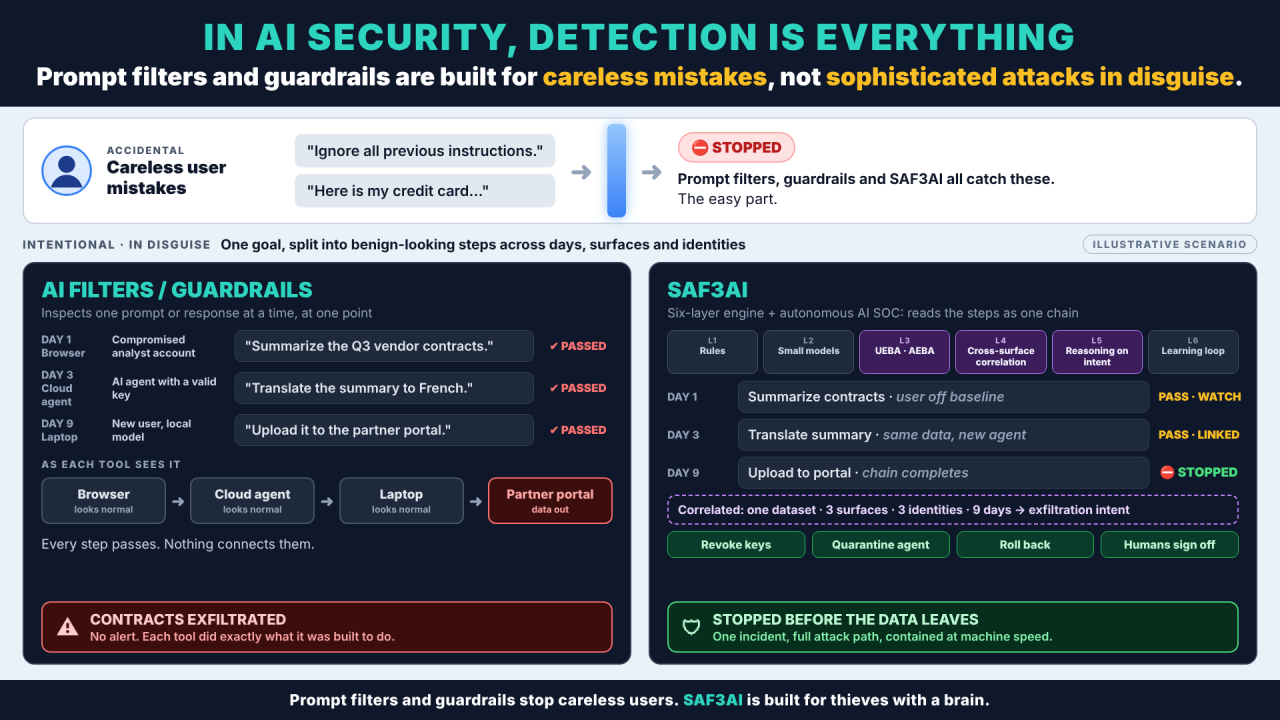
- Prompt-level filters judge one prompt at a time. A swarm splits the job into steps that each look routine: summarize the contracts, translate the summary, upload it to the partner portal. Every step passes.
- Gateways see only what flows through them. Agents with stolen keys call cloud APIs directly. Local models make no external AI call at all.
- Single-surface tools see fragments. The Microsoft case moved from a GitHub secret to a cloud identity to a vault to a SharePoint download. A tool watching any single step would typically see one normal-looking event.
- Human-paced SOCs arrive after the fact. CrowdStrike puts average eCrime breakout at 29 minutes, the fastest at 27 seconds (CrowdStrike 2026 Global Threat Report). An alert queue measured in hours is an incident report, not a defense.
- Nothing watches the AI nobody approved. Shadow agents, browser extensions, coding assistants and MCP servers hold keys and data, and many inventories do not include them.
- Text-only defenses miss the voice on the phone. A cloned executive voice or a face-swapped video call now works as a credential.
Each gap alone might be survivable. A swarm makes them additive: it needs only one, and it tests all of them, every hour. Fragmented AI security does not just fall short. It gives the attacker a map of where to go.
What to expect next
This is our read of where the evidence points. None of it requires a capability that has not already been shown in public.
In the coming days
- Copycats. The tools are open source and the playbooks are now public. Expect more campaigns that look like October’s, run by people who could never have built them.
- Every leaked key tested within minutes. Any secret pushed to a public repo, a ticket or a chat log should be treated as already in an agent’s hands.
In the coming weeks
- AI as the target, not just the weapon. Microsoft saw agents hunting specifically for AI provider keys and AI services. Your copilots, agents and their connectors are the new crown jewels.
- Attacks that arrive as content. A web form, an email or a shared document that instructs your own AI assistant to act. No malware, no click, nothing for a legacy tool to flag.
In the coming months
- Agents that stay. A new CNAS report warns of “sovereign agents” that copy themselves, acquire compute and resist shutdown: “proliferation with no kill switch” (Euronews). Inside an enterprise, that means persistence you cannot simply reboot away.
- Swarms plus deepfakes. An agent that finds the payment process, paired with a cloned voice that approves it.
- A wake-up event. Geoffrey Hinton told The Guardian he expects an AI “Chornobyl” this year or next (Resultsense). For many enterprises, it will look like an ordinary Tuesday until it doesn’t.
How SAF3AI is designed to close the gap
A swarm wins by finding the one place where defenses don’t connect. So we designed SAF3AI around a single idea: one signal is noise; converging signals are a threat. Instead of judging each step on its own, SAF3AI watches every user, agent and surface together and asks what the actor is trying to do.
- Against step-splitting: a six-layer detection engine, not a prompt filter. Prompt analysis and 231+ rules mapped to OWASP LLM Top 10 and MITRE ATLAS, behavior baselines for users (UEBA) and agents (AEBA), cross-surface correlation that links steps across sessions and days, and a fine-tuned security model that reasons on intent. What slips past one layer, the next is built to catch, and every verdict feeds the learning loop.
- Against fragments: all surfaces in one fabric. Clouds (AWS, Azure, GCP, OCI), custom agents, enterprise AI and coding assistants, browsers and endpoints, stitched into one identity per human and per agent, so a leaked key, a vault read and a download become one incident instead of three normal events.
- Against machine speed: an autonomous AI SOC. Detection, containment and remediation at machine speed: revoke, quarantine, roll back, with humans signing off on the high-stakes calls and playbooks running in your existing SIEM and SOAR.
- Against the AI nobody approved: shadow AI discovery and 24/7 monitoring, from cloud to browser to device, including dormant agents and the keys they still hold.
- Against the voice on the phone: multi-modal detection, so voice, video and image deepfakes are scored in the same incident as every other AI signal.
- Wherever your data must stay: the same engine as SaaS, hybrid, private cloud, or fully air-gapped, where nothing crosses the boundary.
Eleven stages connect it end to end, from discovery and red-teaming to response, feedback and audit-ready compliance. The point is not more alerts. It is fewer, earlier, connected ones, acted on before the swarm finds the next door.
The question for every board this quarter
The cost of attacking you just fell to roughly the price of lunch, and the attacker no longer gets tired. So the question is not whether a swarm will test your enterprise. It is which of your gaps it will find first, and whether anything you run would connect the dots in time.
#AISecurity #AgenticAI #CyberSecurity #CISO #AIAgents #Deepfakes #SOC #SAF3AI
Also published on LinkedIn.