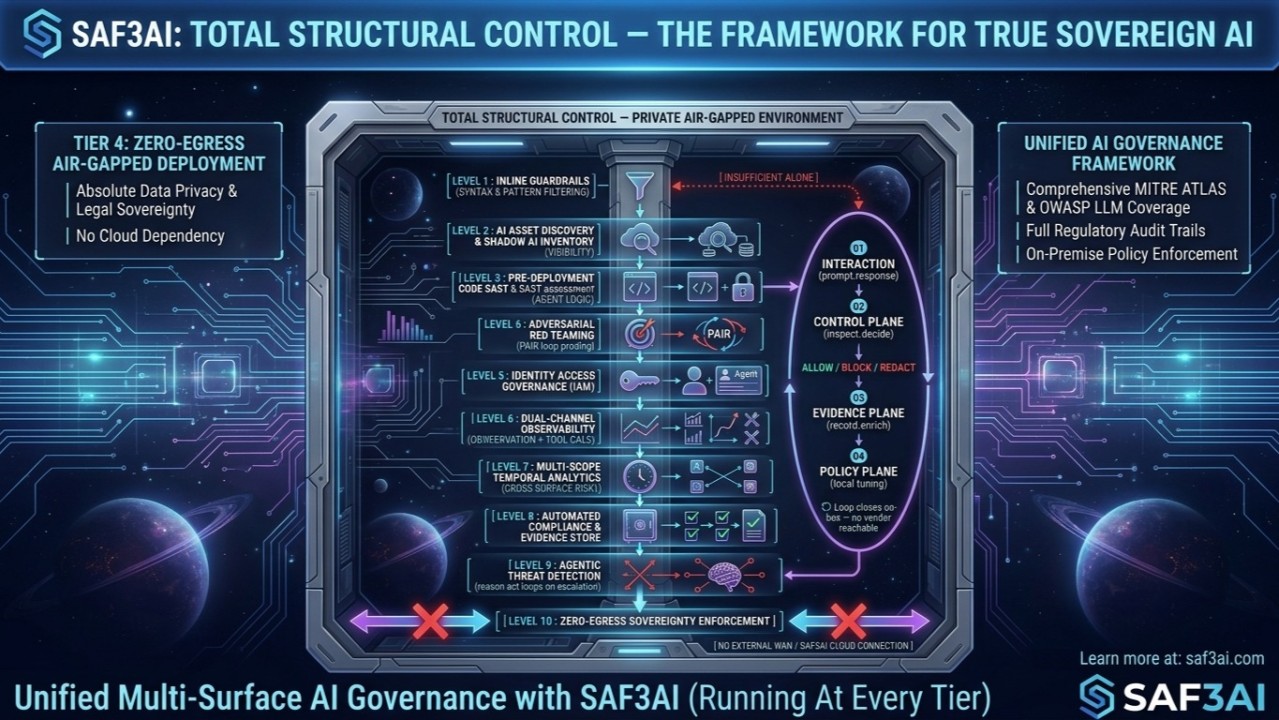
The enterprise discussion surrounding Sovereign AI frequently conflates data residency with genuine operational and legal sovereignty. Storing vector databases in a localized cloud zone or wrapping a foreign public LLM API in an external boundary guardrail fails the foundational test of sovereign posture. Under extra-territorial data regimes (such as the US CLOUD Act), foreign-headquartered hyper-scalers remain subject to disclosure mandates regardless of physical server location. True sovereignty requires absolute decoupling: a zero-egress architecture where data, model weights, execution spans, and system telemetry operate entirely within local jurisdictional and cryptographic control.
Furthermore, evaluating AI security purely through real-time input/output guardrails fundamentally misunderstands the non-deterministic nature of modern AI assets. Guardrails serve as localized, syntax-level text filters. They are incapable of mitigating multi-turn context poisoning, agentic tool abuse, or state manipulation across asynchronous tool-calling chains. In a sovereign environment, governance cannot be treated as an edge-filtering proxy; it must operate as an omnipresent structural fabric across four interconnected pillars:
- Infrastructure Sovereignty: Hardware-level compute isolation and zero-egress VPC/air-gapped orchestration.
- Model & Data Sovereignty: Absolute local authority over model weights, fine-tuning artifacts, and RAG datastores without external API dependencies.
- Operational & Identity Sovereignty: Zero-trust agent authorization (IAM) and execution-level isolation for autonomous workflows.
- Governance Sovereignty: Immutable, locally owned audit trails mapping execution trajectories directly to frameworks like the EU AI Act, NIST AI RMF, and ISO 42001.
The Regulatory Catalyst: Global Compliance Mandates and Extraterritorial Realities
A prime example of regulatory drivers reshaping sovereign adoption is the convergence of strict compliance frameworks across Europe and India. In Europe, the EU AI Act (specifically Article 10’s strict data governance requirements for high-risk models), alongside the Digital Operational Resilience Act (DORA) and the European Commission’s Cloud and AI Development Act (CADA), forces organizations in critical infrastructure and finance to guarantee absolute local control and supply chain transparency. Concurrently, India’s Digital Personal Data Protection Act (DPDPA) and the Reserve Bank of India’s (RBI) Master Directions on IT Governance enforce stringent data localization and complete auditability for financial workloads. In both jurisdictions, regulations demand full algorithmic explainability and strict data lineage. Because foreign public cloud APIs operate as black boxes subject to extraterritorial disclosure mandates (such as the US CLOUD Act), enterprises in both markets are legally constrained from routing sensitive inference traffic across international borders. This regulatory alignment across the EU and India has elevated sovereign private clouds and air-gapped security architectures from a risk-mitigation strategy into a non-negotiable operational prerequisite.
The Fallacy of Guardrails as AI Security
In the rush to deploy AI, many organizations rely on real-time input/output guardrails as their complete security layer. However, guardrails are merely the first—and arguably most naive—of the 10 levels of AI security.
Guardrails perform superficial, real-time checks: stripping explicit PII, filtering toxic words, or blocking known prompt injection syntax.
In a private, air-gapped sovereign deployment, the efficacy and necessity of standalone guardrails drop significantly:
- Context Blindness: Guardrails analyze individual prompts in isolation. They cannot detect multi-turn attacks, gradual context poisoning, or low-and-slow exfiltration campaigns spread across multiple sessions.
- No Behavioral Protection: A guardrail cannot tell if an autonomous agent is abusing its agency, calling unauthorized APIs, or oscillating in broken reasoning loops.
- Workarounds: Autonomous AI agents easily reason around simple text filters (e.g., executing Python scripts to delete files instead of running blocked system commands).
Treating guardrails as your entire AI security stack is akin to locking the front door while leaving the windows, fire escapes, and loading docks wide open.
The 10 Levels of Comprehensive AI Security
True enterprise AI security requires an integrated, multi-tier defense architecture:
- Input/Output Guardrails: Fast, surface-level regex and keyword pattern blocking.
- AI Asset Discovery & Shadow AI Visibility: Real-time inventory of all models, browser extensions, endpoints, and unsanctioned citizen-built agents across the network.
- Pre-Deployment Static Analysis (SAST): Code-level vulnerability analysis of custom agent logic and tool-calling execution flows before deployment.
- Adversarial Red Teaming: Automated, continuous probing (e.g., PAIR loop) to stress-test models for jailbreaks and logic failures before production release.
- Entity & Identity Access Governance: Granular IAM controls governing which humans, agents, and tool integrations can execute specific tasks.
- Dual-Channel Observability: Concurrent tracking of conversation trajectories and downstream tool-call execution spans in a unified context graph.
- Multi-Scope Temporal Analytics: Decay-weighted risk tracking that evaluates behavior across multi-turn sessions, identities, and cross-surface interactions.
- Automated Compliance & Evidence Storage: Immutable, local audit logging mapped directly to global regulatory frameworks (EU AI Act, NIST AI RMF, ISO 42001).
- Agentic Threat Detection & Investigation: Dynamic reasoning loops that correlate complex, multi-stage attack paths across disparate tools.
- Zero-Egress Sovereignty Enforcement: Hard architectural boundaries ensuring that no telemetry, metadata, or prompts ever cross external WAN connections.
How SAF3AI Delivers True Sovereign Security & Governance
SAF3AI replaces legacy point solutions with a unified Multi-Surface AI Governance Platform designed to run natively inside your sovereign boundary.
1. True Tier 4 Sovereign / Air-Gapped Deployment
SAF3AI operates across flexible deployment tiers—culminating in Tier 4 Sovereign (In-a-Box). Designed specifically for government, defense, and highly regulated industries, Tier 4 runs completely disconnected with zero WAN access required. The inspection engines, local security models, signed offline threat-intelligence updates, and full-fidelity evidence stores operate entirely on-box within your private infrastructure.
2. Asynchronous Security Detection Fabric
Instead of relying solely on synchronous gateways, SAF3AI uses an asynchronous, single-substrate detection fabric. Every signal—across any enterprise AI application, agent, surface—is ingested, canonicalized, and scored against a library of 180+ detection rules (mapped to OWASP Top 10 and MITRE ATLAS).
3. Multi-Scope Risk Accumulation SAF3AI tracks attacks that appear completely benign in isolated interactions. By maintaining decaying risk accumulators across users, agents, and multi-turn conversations, the platform identifies multi-stage campaigns, indirect prompt injections (such as EchoLeak-class vulnerabilities), and cross-surface pivoting before data exfiltration can occur.
4. End-to-End Governance for Public Sector & Global Enterprise From auto-discovering shadow AI across enterprise browser endpoints to performing pre-deployment code SAST and automated red-teaming, SAF3AI spans the entire AI lifecycle. Local operators retain full control to tune policies, monitor token FinOps, and generate audit-ready evidence for the EU AI Act, NIST RMF, and ISO 42001—without a single byte ever leaving the sovereign perimeter.
#SovereignAI #AISecurity #AIGovernance #ZeroEgress #PrivateCloud #AIAgentSecurity #DataSovereignty #EUAIAct #DPDPA #RBIMandates #CADA #EnterpriseAI #AirGapped #InformationSecurity #CyberSecurity #SAF3AI
Also published on LinkedIn.