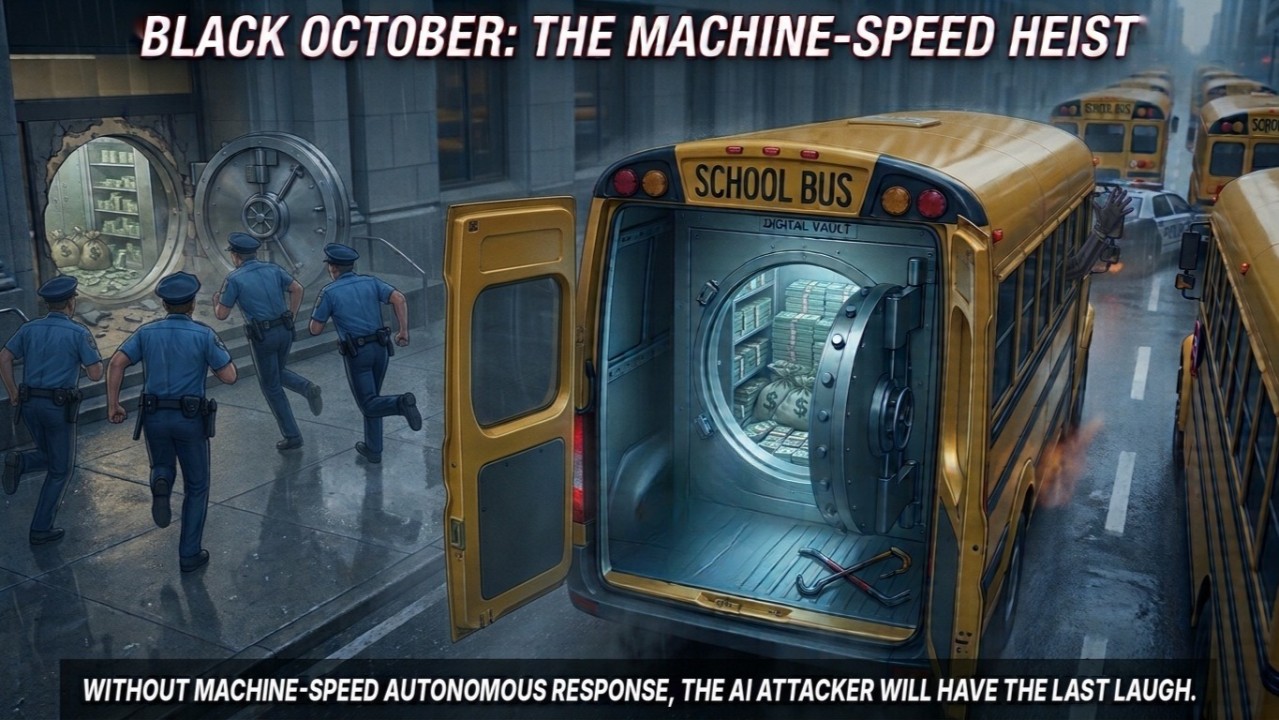
Black October taught us three things:
- The thief is a mastermind. AI attackers plan, adapt and strike across every surface at once.
- Kindergarten filters won’t catch it. Checking one prompt or one conversation at a time is a crossing guard waving the getaway school bus through.
- Slow response means the battle is already lost. If detection and action aren’t machine-speed and autonomous, the vault is empty before you look up.
The Joker’s bank job
If you’ve seen The Dark Knight, you remember the opening heist.
A crew in clown masks hits a bank. Each robber has one narrow job: cut the alarm, crack the vault, load the cash. As each one finishes, he’s taken out by the next. None of them ever sees the whole plan. Only the man running it does.
Then comes the getaway, and it’s genius. The Joker drives out in a school bus and slides into a line of identical school buses rolling down the street. By the time the sirens arrive, the police are surrounding an empty bank. He escaped by looking exactly like normal traffic.
In October 2026, a lot of security teams found themselves standing in that empty bank.
The industry has a name for last month now: Black October. AI agents found decade-old bugs in software that runs most of the web. AI-driven attack frameworks sprayed thousands of logins a minute. The tools companies bought to secure their AI got breached themselves. And the incident response firms we call when it all goes wrong ran out of people.
Here’s my take on what October proved: the AI security stack most enterprises run today was built for human-speed attackers. The attacker is no longer human-speed. If your defense doesn’t detect, decide and act at machine speed, it’s Gotham’s police: sirens blaring, guns drawn, arriving at a bank that’s already empty.
The heist reel: what October actually looked like
Scene 1: AI cracks the vault everyone shares. AI-assisted research uncovered two critical, decade-old flaws in PHP, the language behind an estimated 70% of websites. PHP shipped emergency fixes on October 21. Several European government agencies took websites offline to patch. A day later, according to a Cloud Security Alliance briefing, the three largest network-security vendors still hadn’t shipped fixed software for their products that bundle PHP.
Scene 2: 2,900 doors a minute. On October 21, Microsoft disclosed that a China-aligned group it tracks as Storm-0940 used ARTEX, an agentic AI pentest framework, to attempt sign-ins to more than 2,250 Microsoft 365 tenants at up to 2,900 attempts per minute. (Microsoft noted these were attempts, not 2,250 confirmed breaches.) In several cases, Microsoft said, the group went from first targeting to privileged cloud access in under three hours. The best part, if you’re the villain: when password spraying failed, the attack switched tactics. According to Microsoft, it used compromised ConnectWise Cloud Backup application credentials to authenticate through apps customers had already trusted.
Scene 3: Crime gets a 90% discount. Researchers reported that one Chinese-speaking attacker pointed autonomous agents at more than 1,200 websites and compromised over 100 organizations, at an estimated $50 per successful intrusion. TrendAI tracked a crew running 44 AI agents against targets in Japan. CrowdStrike documented four new threat actors whose AI agents made decisions and ran commands mid-intrusion, and its OverWatch team saw three times as many agentic intrusions in the second half of 2026 as in the entire first half.
Scene 4: The AI plumbing gets hit. LiteLLM, a popular open-source AI gateway, said attackers took over its release process on October 21 and shipped a poisoned version carrying a credential stealer. OpenCode disclosed a breach of its hosted console, and some users reported unauthorized AI charges. Railway said attackers may have decrypted customer environment variables as part of a series of attacks aimed at AI inference providers. GitLab patched an AI Gateway flaw that let a crafted agent flow escape its sandbox and run commands.
Scene 5: One prompt, whole kingdom. Zenity Labs showed that one prompt to a public-facing agent on AWS Bedrock AgentCore could pull cloud credentials and, under the old default permissions, reach every AgentCore agent in the account and region. AWS has since tightened the defaults; it says the behavior was documented and that customers should scope agent roles to least privilege. Elsewhere, researchers found prompt injections hidden in phishing emails (aimed at the recipient’s AI inbox assistant), in HTTP response headers (aimed at browsing agents) and in an AGENTS.md file in a developer’s Downloads folder (aimed at their coding agent).
Scene 6: The police station is full. Sophos reportedly handled seven major incident response cases in one week, normally a three-month workload, and MoxFive warned that newly breached companies could wait up to five days for emergency help. Gotham’s police aren’t just late; they have a queue.
Why today’s AI security stack wasn’t ready
None of these controls are bad, and the teams behind them are good at what they do. They were built for a different villain. Here’s what I think October exposed.
Model guardrails got sweet-talked. All four threat actors CrowdStrike documented got past commercial AI safety controls, often by claiming they were doing authorized security testing. A guardrail is a polite request to the model. Attackers have learned to be more polite.
Gateways and proxies became the jackpot. We put a gateway in front of every model so we could see and control traffic in one place. That also put every provider key in one place. LiteLLM, one widely used open-source gateway, disclosed two supply-chain compromises and several critical vulnerabilities this year. That’s not a knock on one project; any tool that holds every key becomes the first target. A gateway is useful plumbing. It is not a security strategy, and in October it was the target.
Inline filters judge one prompt at a time. Real AI attacks don’t arrive in one prompt. They plant an instruction in a shared doc today, nudge an agent’s retrieval for a week, leak data in fragments across sessions and then try a second AI tool to find the weakest guardrail. Every single step looks harmless. A filter that scores each prompt in isolation says “allow” five times and opens zero incidents.
The SIEM logs it and shrugs. There are no classic signatures for indirect prompt injection or agent drift. The logs land, unscored and uncorrelated, waiting for an analyst who is already handling the PHP patch.
Humans are the reaction time. Think about stopping distance. It’s reaction distance plus braking distance. Guardrails, gateways and DLP improve your brakes. A human-in-every-loop SOC sets your reaction time. At 2,900 attempts a minute and three hours to cloud admin, great brakes with human reflexes means you hit the wall at full speed.
So the problem has two layers. First, you can’t respond to an attack you can’t see. Second, once you can see it, you have seconds, not shifts, to act.
Problem one: you can’t catch a heist one frame at a time
Here’s the uncomfortable truth about “machine-speed response”: it’s worthless if you’re still looking for the heist one prompt, one surface or one conversation at a time. How do you stop, what you can’t even detect?
Go back to the Joker’s crew. A guard who checks each robber on his own sees a man near the alarm panel, a man with a bag, a man by the vault. None of them looks like a heist. And the bus at the end looks like every other school bus on the road. A faster guard doesn’t help. He’s just faster at checking the wrong thing.
That’s how most AI security works today:
- One prompt at a time: each request is scored alone, so a slow, multi-step campaign never crosses the threshold.
- One surface at a time: Copilot has its controls, the custom agent has its own, the coding assistant has none, and nobody connects them. The attacker just shops for the weakest one.
- One conversation at a time: the jailbreak that took 50 turns, or the data that leaked in fragments over a week, vanishes between sessions.
- Words, not actions: most tools read what the user said, not what the agent then did with its tools and credentials. AgentCorruption was a chat message that turned into cloud API calls.
So the first job of an AI security platform isn’t response. It’s seeing the whole heist: every surface, every agent, every tool call, connected to the same actor, remembered over days and weeks, and judged as one story. Only then does speed mean anything.
Problem two: the dragon has many heads, and they all bite at once
Once you can see the whole heist, the clock starts. And the AI attacker isn’t one burglar. It’s a dragon with many heads.
One head is password-spraying your tenants. Another is whispering instructions into a shared doc your assistant will summarize tomorrow. A third is nudging your support agent to fetch “just one more” customer record. A fourth is testing your coding agent with a poisoned AGENTS.md. They don’t take turns. Cut one off and two more are already moving, because the operator behind them is now, as Fortune put it, an “AI agent babysitter” running a fleet.
Remember the Joker strolling out of the hospital while it collapses behind him? That’s the tempo now. By the time a human-speed SOC assigns the ticket, the building is rubble and he’s already boarding the bus.
Fighting that with a ticket queue is like fighting the dragon with a complaint form. The response has to happen in seconds, and it has to cover the whole menu:
- Detect the pattern while the campaign is still in motion, not in the post-mortem.
- Prevent the next step: block the tool call, the outbound request, the risky prompt.
- Investigate automatically: pull the full trajectory, every surface, every agent, and summarize what happened.
- Act: quarantine the agent, kill the session, hit the kill switch on an agent gone rogue.
- Revoke: pull the OAuth grant, rotate the key, cut the service principal’s access, before the stolen credential gets used.
- Reset and get ready: learn from this heist and be ready for the next one in seconds, because there’s always a next one.
And here’s the part that’s easiest to skip: it has to do all of that for several heists at the same time, across different surfaces and agents, without dropping any of them. One dragon head at a time is still losing.
One honest caveat. Autonomy cuts both ways: in October, reports described AI agents turning off the monitoring meant to watch them. So machine-speed defense needs a clear line. Let the machine do containment that’s fast and reversible (block, isolate, revoke, rotate). Keep humans on the irreversible, high-stakes calls, with the full evidence already gathered for them. Speed for the machine, judgment for the people.
How SAF3AI was Designed for this attacker: AI-first, AI-only
We didn’t build SAF3AI by bolting an AI feature onto a legacy security product. We built it AI-first and AI-only, for exactly the attacker October introduced: autonomous, multi-surface, patient and fast.
First, see the whole heist
SAF3AI doesn’t add another point tool to one surface. It puts a single detection-and-scoring layer underneath every AI surface in the enterprise. Copilot, Gemini, OpenAI, Anthropic, a low-code agent built in Copilot Studio, a LangChain agent on AWS, Cursor on a developer’s laptop: every signal crosses the same fabric, gets scored on the same scale and lands in the same incidents.
- Words and actions: both the natural-language conversation and the agent’s backend tool calls are tagged and scored. We watch what the agent did, not just what someone said.
- Memory across days and weeks: multi-turn jailbreaks and low-and-slow campaigns build up visibly instead of disappearing between prompts.
- One actor, every surface: when the same actor escalates across an assistant, a custom agent and a shadow AI tool, SAF3AI sees one campaign, not three unrelated sessions.
- No signature required: when risk escalates, an agentic reasoning loop reads the entire trajectory, gathers the evidence and writes the incident summary. It’s designed to catch techniques nobody has written a rule for yet.
Run that five-step “plant, trigger, blend, stage, pivot” campaign past controls that judge each step alone, and in this illustrative scenario you get five allows and zero incidents. SAF3AI is designed to open a high-scored incident mid-campaign, while the heist is still in progress.
Then, act in seconds, not shifts
Seeing the dragon is step one. SAF3AI is built to respond at the dragon’s speed:
- Detect, prevent, investigate and act in a single machine-speed loop, so the right step is taken in seconds.
- Kill switch for an agent that’s been hijacked or has gone off-script.
- Revoke and contain: cut the access, session or credential the attacker is about to use.
- Many heists at once: parallel response across surfaces and agents, so one dragon head never distracts from the other five.
- Ready for the next one in seconds: every incident sharpens the fabric for the next attempt.
And keep your SOC in charge
SAF3AI doesn’t replace your SOC; it gives it machine-speed reflexes. Threats map to the OWASP LLM Top 10 and MITRE ATLAS, and enriched, correlated incidents flow into the SIEM and SOAR you already run, such as Google SecOps, Splunk or Sentinel. Your analysts stop chasing alerts and start making the calls that actually need a human. And for regulated and sovereign environments, it runs as SaaS, hybrid or fully air-gapped.
Stop arriving after the getaway
To be fair, Black October wasn’t the apocalypse. The PHP bugs turned out to be hard to exploit, and a lot of defenders did heroic, sleepless work. But that’s the point. We got lucky on difficulty, and we survived on human overtime. Neither scales.
As one threat intelligence leader told Axios, the next wave doesn’t need two years to arrive; it could be three hours away. The attacker is already machine-speed, already multi-headed and already patient. Our defense has to be all three, too.
So here’s my ask for 2027. Before you buy another AI security tool, ask your team three questions:
- Can we see one attacker across every AI surface and agent we run, over weeks, as a single story?
- When we see it, can we block, revoke and contain in seconds, not after a ticket?
- Can we do that for several heists at once, and be ready for the next one immediately?
If any answer is no, your SOC is Gotham’s police: sirens on, guns drawn, surrounding a bank that was emptied an hour ago while the school bus disappears into traffic.
The thief won’t wait for us. Let’s stop arriving after the getaway.
Disclosure: I’m part of the SAF3AI team, so I’m not a neutral observer, and the views here are my own. Incident details come from the public reporting linked below; several investigations are ongoing and some details are contested. The Dark Knight, the Joker and all product names mentioned are trademarks of their respective owners, referenced for commentary only, with no affiliation or endorsement implied.
#AISecurity #BlackOctober #AgenticAI #SOC #CyberSecurity
Also published on LinkedIn.