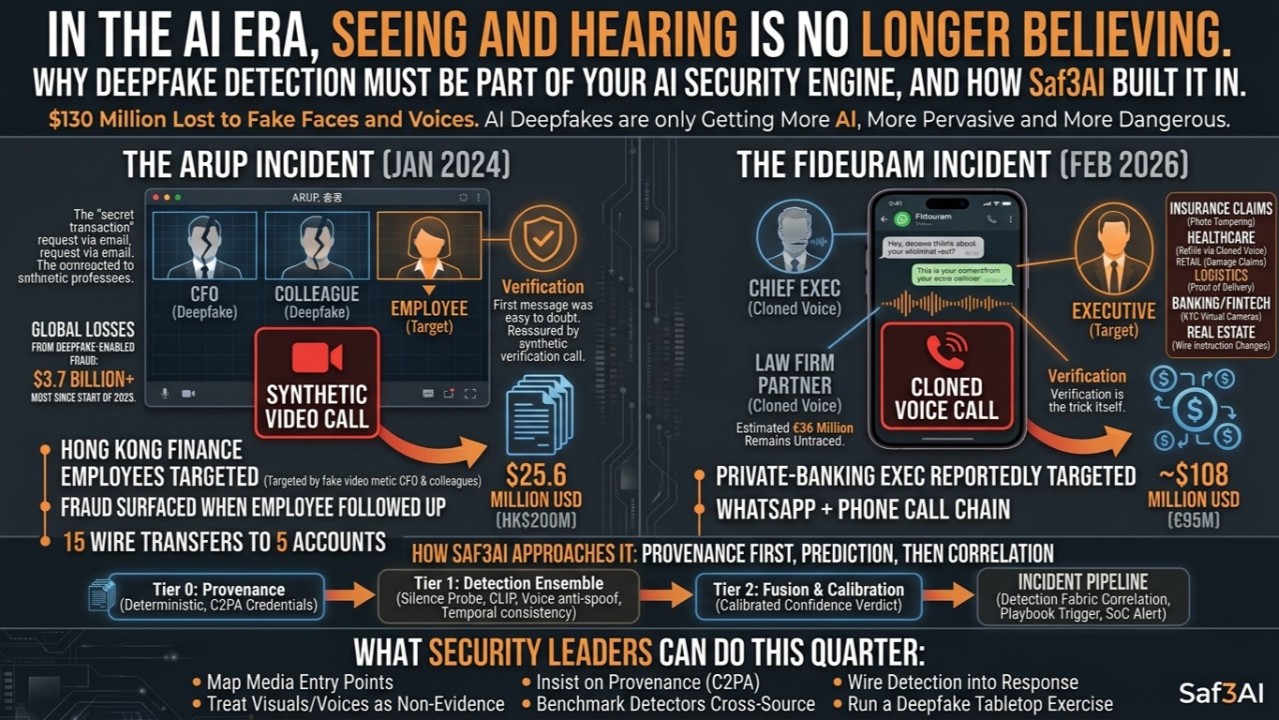
$130 Million Lost to Fake Faces and Voices. AI Deepfakes are only Getting More Real, More Pervasive and More Dangerous.
In September, Reuters reported, citing people familiar with the matter, that fraudsters using AI to impersonate senior executives moved about €95 million (roughly $108 million) out of Fideuram, the private-banking arm of Intesa Sanpaolo. According to those reports, the scheme relied on a WhatsApp message and a cloned voice. The bank has not commented publicly.
Two years earlier, a finance employee at Arup’s Hong Kong office wired about $25 million after a video call in which every other participant, including the CFO, was a deepfake.
Cases like these are no longer rare. One industry study, built from public incident records, puts documented global losses from deepfake-enabled fraud at $3.7 billion or more, most of it recorded since the start of 2025.
The lesson is uncomfortable for security teams. Deepfakes have moved from a misinformation story to a business-process risk, and many enterprise security stacks have no sensor pointed at them.
Anatomy of the two attacks
Neither attack needed a technical breakthrough. Both exploited the same assumption: that a familiar face or voice is proof of identity.
Arup, January 2024 (video)
- A phishing email posing as the UK-based CFO asked a Hong Kong finance employee to carry out a “secret transaction.” The employee was suspicious.
- The attackers then invited the employee to a video conference. The CFO and several familiar colleagues appeared on screen, all synthetic.
- The deepfakes kept the conversation short and stuck to instructions, which limited the chance of a slip.
- Reassured, the employee made 15 transfers totalling HK$200 million (about $25.6 million) to five Hong Kong bank accounts.
- The fraud surfaced only when the employee later followed up with head office.
Fideuram, February 2026 (voice, as reported)
- A senior Fideuram executive reportedly received a WhatsApp message that appeared to come from the group’s CEO, asking for urgent help with an overseas transaction.
- A follow-up call reportedly came from someone who sounded like a law-firm partner the executive knew. Per the reports, that voice had been cloned with AI.
- Over a few days in late February, about €95 million was reportedly transferred to overseas accounts, mainly in China and Hong Kong.
- A large share was later recovered with help from authorities in several countries. An estimated €36 million reportedly remains untraced, though the figures differ between reports.
- The case was first reported publicly on 25 September 2026. Intesa Sanpaolo and Fideuram have declined to comment.
Notice what the attackers did in both cases. The first message was easy to doubt. The second channel, a live face or a trusted voice, was designed to remove that doubt. In the Arup case, the “verification” step was the trick itself.
Why “train people and call back” is no longer enough
The standard advice after Arup was sensible: train staff, verify out of band, require dual approval. Keep doing all of it. But on its own, it rests on three assumptions that no longer hold.
People can spot a good fake. They mostly cannot. One study cited in 2026 coverage found people correctly identify high-quality deepfake videos only 24.5% of the time. A few seconds of public audio, from an earnings call or a conference talk, is enough to clone an executive’s voice.
A second channel is a safe channel. Not when attackers control both. In the reported Fideuram case, the message and the confirming call were both fake. A call-back only helps if the number, the person and the voice on the other end are all genuine.
The threat arrives through a few known doors. It doesn’t. Synthetic media now reaches a company through Teams and Zoom calls, voice notes, KYC selfies, onboarding documents, invoices and screenshots uploaded to AI assistants. Increasingly, it also flows into AI agents that read images and audio and act on them without a human ever looking.
That last point is the one most programs miss. Awareness training protects people. It does nothing for an AI agent that processes a forged invoice at 3 a.m.
Why deepfake detection has to live inside the security platform
Most deepfake detection today is sold as a standalone tool: upload a file, get a score. That is useful for a forensic team. It is the wrong shape for enterprise defense, for four reasons.
1. A deepfake is rarely the whole attack. It is one step in a chain. At Arup, the chain was a phishing email, then a synthetic video call, then 15 wires to new accounts. A standalone detector sees one artifact; a platform sees the chain. A “possibly synthetic” score on a voice note means little alone. The same score becomes an incident when it is attached to someone who just received an unusual payment request through a new channel, minutes before a first-time transfer.
2. The attack surface is now AI-mediated. Media no longer lands only in an inbox. It gets pasted into Copilot, summarized by Gemini, read by a claims-processing agent, or attached to a ticket an agent will act on. The security layer already watching those AI flows for prompt injection and data leakage is the natural place to inspect the media flowing through them. Bolting on a separate tool means a separate integration, a separate console and a separate blind spot.
3. Detection without response is just a report. A score that lands in a dashboard nobody watches does not stop a wire. Detection has to feed the same pipeline as every other signal. Then it can raise an incident, enrich it with identity and context, and trigger a playbook: hold a payment, force step-up verification or alert the SOC.
4. Auditors and regulators will ask what you did. The EU AI Act includes transparency obligations for AI-generated and manipulated content, and financial supervisors are paying growing attention to AI-enabled impersonation. One audit trail across AI activity, data movement and media verdicts is far easier to defend than three separate ones.
In short, deepfake detection is not a product category of its own. It is a sensor, and a sensor is only as useful as the system it feeds.
The uncomfortable truth about deepfake detectors
Here is what the vendor slide rarely says: most detectors look excellent on the data they were trained on and much worse on media from a generator they have never seen. Some industry analyses report accuracy drops of 45–50% when detectors move from lab benchmarks to real-world deepfakes.
That gap matters because attackers don’t use last year’s generator. A detector tuned to yesterday’s fakes can perform near chance on tomorrow’s.
So the right question for any deepfake detection capability is not “what’s your accuracy?” Ask these instead:
- What is your score on a generator you did not train on? Cross-source testing is the only honest benchmark.
- What do you check before you guess? Cryptographic provenance (C2PA content credentials), metadata and hashes against known assets are evidence. A model score is an opinion.
- What happens when you’re unsure? A borderline result should be shown as borderline and routed to a person, not rounded to “real.”
- Where does the verdict go? If the answer is “a dashboard,” it won’t stop a wire.
How SAF3AI approaches it: provenance first, then prediction, then correlation
At SAF3AI, we built deepfake detection as a native layer of our AI security platform, not a bolt-on. It runs across image, audio and video, and it was designed around the generalization problem above. The pipeline has three tiers, and every verdict feeds the same Detection Fabric as every other signal.
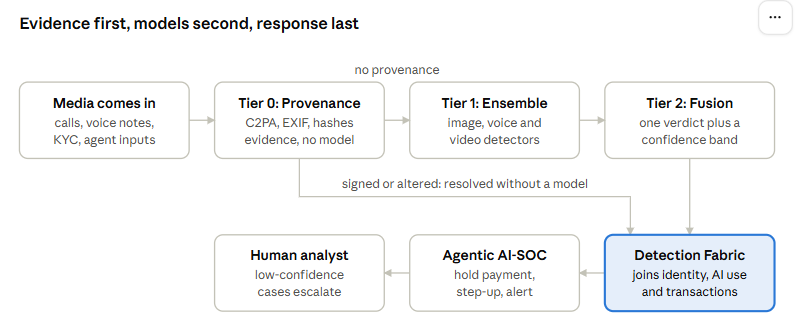
Provenance resolves what it can without a model. Only unresolved media reaches the ensemble, and every verdict lands in the same incident pipeline.
Tier 0: Provenance (deterministic, runs on every item). C2PA content credentials, EXIF metadata and perceptual hashing against known assets run first. Where provenance answers the question, no model is consulted at all. Signed media is verified, not guessed at. Altered media with intact provenance is caught deterministically.
Tier 1: Detection ensemble (runs only where provenance is silent). A router sends only unresolved media to the models:
- Images run a frozen CLIP encoder with a trained linear head, plus two independent vision transformers.
- Audio runs a WavLM-based voice anti-spoofing probe, the layer that matters for a cloned call.
- Video combines frame-level and audio-track analysis with temporal consistency, the layer that matters for a synthetic meeting.
Tier 2: Fusion and calibration. Scores are calibrated and fused using each detector’s weight and how far the detectors agree. When the models disagree, confidence drops instead of being averaged away. The output is one verdict with a confidence band and the factors behind it. Low-confidence results escalate to a person rather than auto-resolving.
Then: into the incident pipeline. This is the part a standalone tool can’t do. Media verdicts feed SAF3AI’s Detection Fabric as another tier, keyed to the same entities as every other signal. A synthetic asset correlates with who used it, which AI assistant or agent touched it, and what it reached. From there, our Agentic AI-SOC can triage, investigate and trigger a response.
Teams can call the engine three ways, all using the same engine and returning the same verdict shape:
- A command-line tool for one-off checks
- An HTTP endpoint for their own pipelines, such as a KYC flow, a claims intake or a payments approval step
- A fabric worker that consumes media continuously
We’re also candid about limits. We test cross-source, training on one dataset and evaluating on a completely different one, and we treat the worst number as the real number. Our advice: ask any vendor, including us, what their detector scores on a generator it has never seen.
How attacks like these could surface (illustrative)
- A synthetic video call: the inbound “CFO” email, the meeting invite and the payment requests sit on one entity timeline. Video and audio-track analysis returns a synthetic verdict with its confidence band. The fabric links it to a first-time, high-value transfer request, and a playbook can hold the transfer pending out-of-band verification.
- A cloned voice: a voice note or recorded call is scored by the audio anti-spoof probe and correlated with an unusual messaging channel and an urgent overseas transfer. Together they become one incident instead of three unconnected events.
These are illustrative scenarios, not statements about either company’s systems or about what would have happened in those specific incidents.
Beyond the boardroom: where else synthetic media gets in
CEO fraud makes the headlines, but the same technique works anywhere a business makes a decision based on a photo, a voice or a video. That evidence is now cheap to generate, and the decision is increasingly made by an automated workflow or an AI agent. Here is where deepfake detection earns its place outside the finance team:
- Insurance claims. Damage photos and videos can be generated or edited to inflate a loss or invent one, and invoices or repair estimates can be fabricated. A cloned policyholder voice can ask a call center to change the payout account. Detection runs at claims intake, before an adjuster or a claims agent approves anything.
- Healthcare. Telehealth visits depend on knowing who is on the screen, on both sides. Requests to release records or refill prescriptions often arrive by phone. Manipulated images can be submitted with prior-authorization or reimbursement claims. Detection protects patients, clinicians and PHI at each of those points.
- Retail and e-commerce customer service. “Item arrived damaged” refund claims can now come with AI-generated photos. Voice-cloned callers can take over customer accounts through support lines. Detection screens refund evidence and flags synthetic voices before an agent, human or AI, issues a refund or resets an account.
- Deliveries and logistics. Proof-of-delivery photos can be faked, and doctored images can back up “never received” disputes. Driver and courier onboarding increasingly relies on selfie checks. Detection verifies the evidence on both sides of the doorstep.
- Banking and fintech onboarding. KYC selfies, liveness videos and ID documents are prime targets, including fake feeds injected through virtual cameras. Detection sits inside the onboarding pipeline, alongside provenance checks on the submitted media.
- Hiring and HR. Authorities have warned that deepfakes are being used in remote job interviews to gain insider access. Detection on interview recordings and identity checks helps confirm that the candidate you hire is the person you interviewed.
- Real estate, legal and escrow. Last-minute changes to wire instructions, “confirmed” by a familiar voice, are a classic fraud pattern. Detection adds a check on the confirming call before funds move.
- Brand and executive protection. A fake video of a CEO announcing a recall, a layoff or a breach can move markets and customers before anyone responds. Detection helps communications and security teams verify, and refute, fast.
- Public sector and benefits. Benefits claims, citizen identity checks and remote services all accept photos, documents and video. Detection protects public funds without forcing every citizen through manual review.
The common thread is that the media is evidence, and the decision attached to it is valuable. Every case comes down to the same three steps: check provenance first, score what can’t be proven, and send the verdict to the system that can act on it. That is why we built one engine with three ways in:
- The HTTP endpoint, inside a claims, refund or onboarding pipeline
- The fabric worker, for continuous inspection of media flowing through AI assistants and agents
- The command-line tool, for investigators
What security leaders can do this quarter
- Map where media enters your workflows. Include meeting platforms, messaging apps, KYC and onboarding, claims and invoices, and every AI assistant or agent that accepts images, audio or video.
- Treat “I saw them on video” and “I heard their voice” as non-evidence for any payment, credential reset or access change. Write that into policy.
- Put hard process controls on high-value transfers. That means dual approval, call-backs to numbers held on file (never ones supplied in the request), and a cooling-off period for first-time beneficiaries.
- Insist on provenance. Ask vendors and internal teams to sign media with C2PA where possible, so verification becomes a check rather than a guess.
- Benchmark detectors cross-source. Ask every vendor for results on generators they did not train on.
- Wire detection into response. Media verdicts should land in the same incident pipeline as identity, data and AI-activity signals, with playbooks that can pause a transaction.
- Run a deepfake tabletop exercise. Rehearse a synthetic video call and a cloned-voice call with finance and the executive office.
The bottom line
Both above mentioned real incidents involved established organizations and attacks built specifically to beat human judgment. The lesson is not that someone was careless. It is that a convincing face or voice is no longer proof of anything.
The answer is not to ask people to become better lie detectors. It is to give the security stack a sensor for synthetic media: one that checks evidence before it guesses, admits uncertainty, and feeds the same system that already watches your identities, data and AI.
That is why we built deepfake detection into SAF3AI as part of the platform, not beside it.
If you want to see how a synthetic voice or video would surface in your own environment, I’m happy to walk you through it. Comment below or reach out directly.
#AISecurity #CyberSecurity #FraudPrevention #SAF3AI #deepfakes
Also published on LinkedIn.