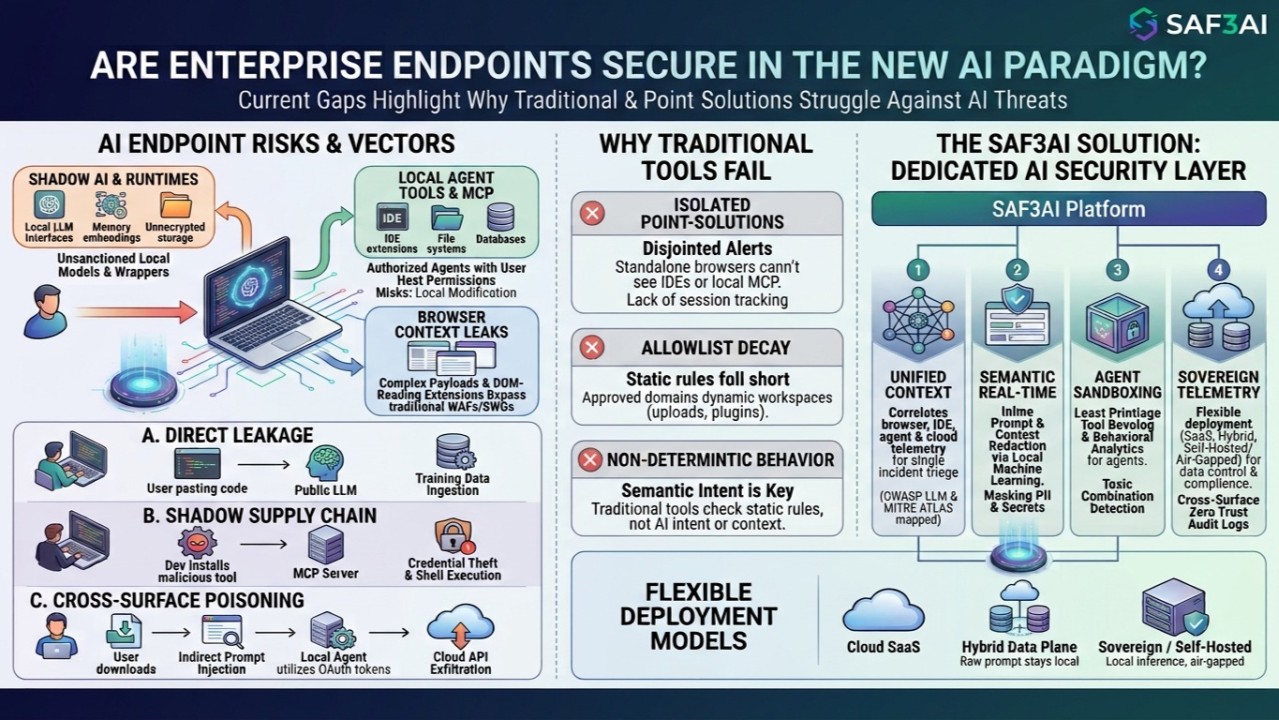
The enterprise security perimeter has shifted toward the endpoint. Browser tabs, IDE extensions, local desktop runtimes, and local Model Context Protocol (MCP) integrations on employee laptops are now where unstructured intellectual property transforms into active model context.
Endpoint security exposes enterprise AI risk because it represents an operational friction point: employees utilize LLM access to support productivity, but prompts, document uploads, and local extensions introduce potential vectors for data exposure, execution tampering, and cross-surface compromise.
1. Core Challenges of Endpoint AI Security
Endpoint security in the AI era presents specific difficulties because the primary vector is often authorized user behavior mixed with non-deterministic agent capabilities inside trusted local environments.
Unsanctioned Local Runtimes & Shadow Infrastructure
Employees may run local LLM interfaces, execution wrappers, or unvetted desktop applications. These interfaces can bypass central network proxies, running prompt histories and local vector embeddings in memory or unencrypted local storage—outside the visibility of standard endpoint management tools.
MCP & Local Agent Tool Sprawl
The adoption of the Model Context Protocol (MCP) allows local desktop apps and IDEs to grant AI agents direct access to local file systems, databases, and microservices.
The Exposure: MCP servers act as execution bridges. When an agent performs actions locally on a user’s behalf, it inherits the user’s host permissions—blurring the line between an informational query and a local system modification.
Browser-Level Context Stripping
Browsers serve as a primary gateway to public LLMs and custom GPTs. Standard Web Application Firewalls (WAFs) and Secure Web Gateways (SWGs) inspect URLs and domain reputations, but they may not parse payload context embedded within complex JSON streams or WebSockets used by conversational interfaces. Extensions can read the browser’s Document Object Model (DOM) and pass context into external AI services without triggering network blocks.
The All-Surface Interdependence Problem
Endpoint security functions alongside cloud infrastructure in a continuous loop:
- Cloud-to-Endpoint Leakage: An enterprise can secure its cloud infrastructure and vector databases, but if an authorized user queries that private cloud data from an endpoint running an unmonitored local extension, the output can be intercepted at the host layer.
- Endpoint-to-Cloud Poisoning: An employee downloading an unverified dataset or prompt containing hidden instructions onto a laptop can sync that file upstream into the enterprise cloud RAG pipeline, altering the internal knowledge base.
2. Real-World Breach & Exposure Scenarios
- Scenario A: Trade Secret & Contract Exfiltration via Web Interfaces: Engineers pasting source code to debug algorithms or sales reps uploading customer contracts to summarize terms. Because endpoints may lack semantic context DLP, proprietary IP and contract terms can flow into public training pipelines.
- Scenario B: Unverified MCP Extensions & Tool Poisoning: A developer installs a third-party MCP tool locally to automate database queries. Via Tool Poisoning, hidden instructions in the tool’s metadata direct the desktop AI client to run local shell commands, read environment variables (.env), and export API keys to a remote server.
- Scenario C: Cross-Surface Document Summarization Attack: An account manager opens an external vendor contract containing hidden text instructions (Indirect Prompt Injection). When the local AI desktop agent scans the document, it executes the instruction: utilizing active OAuth tokens stored in the browser session to access cloud CRM endpoints and transfer customer records.
3. The Management Complexity: Why Traditional Tools & Isolated Point-Solutions Fall Short
Managing AI endpoint risk involves moving beyond domain allowlisting, static blocking strategies, or standalone AI point-tools.
Limitations of Point-Solutions
Deploying isolated point-solutions—such as standalone browser extensions for prompt sanitization, static regex guardrails, or siloed shadow AI discovery tools—presents structural limitations:
- Contextual Blind Spots: A standalone prompt-scanning browser plugin generally cannot see local IDE extensions, desktop runtimes, or local MCP server tool calls. It evaluates prompts in isolation without tracking broader session history or host-level actions.
- Alert Overhead and Lack of Correlation: Point-solutions may generate disjointed alerts without linking the multi-surface attack graph. If an indirect prompt injection occurs in a browser and subsequently triggers a shell execution in a desktop IDE, point-tools treat them as unrelated events rather than a single multi-stage sequence.
- The Allowlist Decay Problem: An approved domain (e.g., a sanctioned enterprise AI portal) remains an active workspace. Once allowed by network tools, users can upload files, run plugins, paste text, or connect external APIs. The domain stays the same, while the underlying risk profile evolves.
- Non-Deterministic Policy Enforcement: Traditional tools rely on static rules (e.g., Block POST to domain X). AI interactions require evaluating semantic intent. Discerning the difference between a standard query and an IP leak involves inspecting context meaning at the host level without adding significant latency.
- Employee Workarounds & Shadow AI: Restricting access to AI tools can lead employees to personal devices or unmanaged browsers, reducing operational visibility.
- Identity Drift & Asymmetric Context: Cloud API gateways observe what data is requested, but endpoints capture how it was triggered. When local AI agents use cached credentials to access internal cloud APIs, standard monitoring tools struggle to distinguish between human intent and an automated agent loop.
4. The SaaS Dilemma & Sovereign AI Requirements
When selecting an AI endpoint security architecture, organizations evaluate how Cloud/SaaS-based security platforms align with their security posture and regulatory requirements.
Evaluating SaaS-Based AI Security Platforms for Endpoint Protection
Cloud-native (SaaS) AI security platforms offer updated threat intelligence and cross-tenant learning. However, they present trade-offs regarding data handling:
- Metadata and Prompt Hairpinning: To analyze whether a prompt contains sensitive IP, indirect prompt injections, or policy violations, many SaaS security platforms transmit raw prompt content, clipboard actions, or metadata back to the vendor’s cloud for evaluation.
- Third-Party Exposure: Transferring data to a SaaS security vendor shifts storage risk to a third party. If that vendor encounters an issue, enterprise data could be exposed.
- Regulatory Factors: Under frameworks like the EU AI Act, GDPR, HIPAA, or financial industry regulations, sending prompt data to an external SaaS security cloud requires careful compliance review.
The Sovereign AI Approach: Regulated & High-Security Environments
For organizations operating under data sovereignty requirements, national defense, government contracting, or strict regulatory mandates, third-party SaaS AI endpoint security may not fit policy constraints. Sovereign endpoint AI security focuses on keeping prompt, code, vector, or inspection metadata within the organization’s controlled boundary:
- Self-Hosted & Localized Data Plane: DLP, prompt sanitization, and model guardrails execute locally on the endpoint host or within the company’s dedicated Virtual Private Cloud (VPC) / air-gapped data center.
- Local Telemetry Management: Security inspection logs and audit traces write to customer-owned storage rather than external SaaS analytics platforms.
- Local Enclave Processing: Modern sovereign setups can utilize Confidential Computing directly at the endpoint or private infrastructure, ensuring data processes within isolated hardware boundaries.
5. How SAF3AI Addresses Enterprise Endpoint AI Security
To address the vulnerabilities left by traditional tools and isolated point-solutions, the SAF3AI Platform provides a dedicated detection and governance engine engineered for the AI execution layer. SAF3AI aligns with core enterprise requirements for securing modern AI environments:
1. Unified Context Graph
Rather than analyzing endpoint events in isolated silos, SAF3AI correlates telemetry across AI surfaces—browsers, IDEs, desktop runtimes, local MCP tools, and enterprise cloud APIs—into a single Context Graph.
- Single Case Triage: If an indirect prompt injection originates in a browser and attempts to execute a local shell command in an IDE, SAF3AI groups the multi-stage path into a unified incident.
- Structured Classifiers: Uses behavioral detection and rules mapped to the OWASP LLM Top 10 and MITRE ATLAS framework alongside standard regex filters.
2. Semantic Real-Time DLP via Local Machine Learning
Rather than routing sensitive payloads to external cloud inspection services, SAF3AI deploys local detection models.
- Inline Interception: Inspects prompt text, attachments, local vector inputs, and clipboard pastes inside the local browser, IDE, or desktop runtime before the request leaves the host.
- Contextual Sanitization: Uses ML classifiers to mask, anonymize, or truncate sensitive data (PII, secret keys, proprietary source code fragments) inline prior to external transmission.
3. Local MCP & Agent Sandboxing with Behavioral Analytics (AEBA)
SAF3AI treats local agents, IDE extensions, and Model Context Protocol (MCP) servers as non-human identities with assigned permissions.
- Tool Scoping & Behavioral Baselines: Maps standard agent behavior and restricts local agents to defined execution boundaries with least-privilege host file access.
- Toxic Combination Detection: Evaluates the context graph to identify risky combinations—such as an agent reading an external document with an indirect prompt injection and attempting to invoke a write-scoped local tool or shell command.
- Managed Agentic Response: Provides automated response workflows with configurable autonomy gates. SAF3AI can quarantine suspicious contexts or revoke temporary tool credentials with logged, reversible action paths.
4. Managed Browser & Desktop Workspace Controls
To monitor DOM context-scraping and shadow AI interfaces:
- AI-BOM Discovery: Discovers AI models, local execution wrappers, browser extensions, and desktop assistants active on employee devices to compile an active AI Bill of Materials (AI-BOM).
- Workspace Isolation: Enforces session isolation for non-sanctioned web LLMs and prevents browser extensions from scanning DOM elements in tabs running sensitive enterprise applications.
5. Flexible Sovereign Deployment Architecture
SAF3AI offers deployment models based on organizational risk thresholds:
- Cloud SaaS: Managed deployment option.
- Hybrid Data Plane: Metadata syncs to the cloud console, while raw prompts, responses, and code remain within the enterprise network boundary.
- Self-Hosted / Air-Gapped Sovereignty: Runs entirely inside customer-controlled infrastructure (Kubernetes or bare metal) with local models and local telemetry management. Designed to align with EU AI Act, DORA, and ISO 42001 frameworks.
Conclusion
Point-solutions and static network controls often lack the broader context required to evaluate non-deterministic, multi-surface AI workflows. Managing modern endpoint risk involves a dedicated defense model. By moving beyond fragmented plugins toward SAF3AI’s unified Context Graph, local DLP, agent sandboxing, and sovereign deployment options, organizations can enable employees to utilize local AI capabilities while maintaining visibility over corporate data and infrastructure. Unified Enterprise AI platform for AI Monitoring.
#AISecurity, #EndpointSecurity, #CISO, #DataLossPrevention, #CyberSecurity #SAF3AI
Also published on LinkedIn.