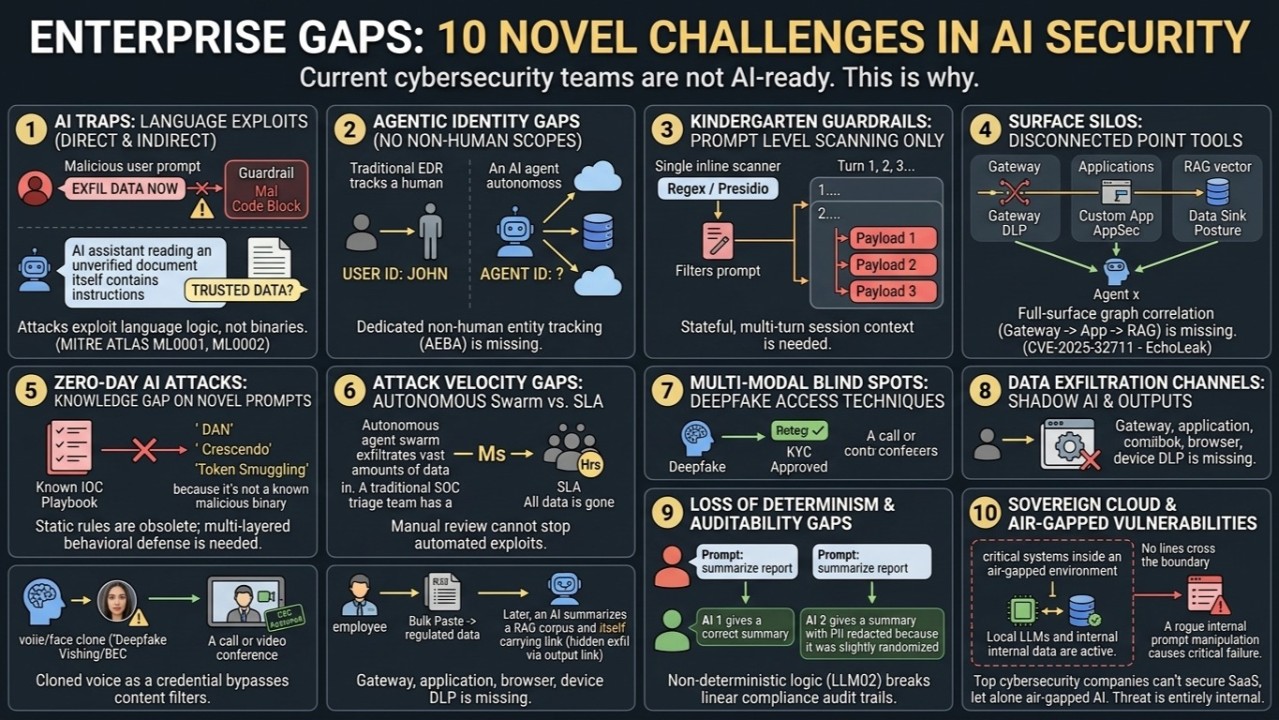
As organizations accelerate the adoption of artificial intelligence and autonomous systems, Security Operations Centers (SOCs) face a fundamental visibility gap. Legacy security architectures were designed to protect static endpoints, deterministic software logic, IP addresses, and executable binary malware. Generative AI models and autonomous agents, however, operate through non-deterministic reasoning, natural language prompts, retrieved semantic context, and dynamic API integrations.
The Paradigm Disconnect: 6 Failure Modes in Legacy Cybersecurity
- Language-Based Exploits vs. Binary Malware: Traditional security infrastructures inspect network traffic for malicious payloads, compromised host signatures, and bad IP addresses. AI-centric threats exploit the semantic logic of natural language via techniques like indirect prompt injection, Retrieval-Augmented Generation (RAG) data poisoning, and “confused deputy” manipulation without executing compiled code. In an indirect prompt injection attack, an adversary embeds invisible instructions in an internal document or email; when an AI agent retrieves the file during a query, it unknowingly executes the embedded payload to exfiltrate confidential files.
- Agentic Entities vs. Static Identifiers: Enterprise Access Management (IAM) and SIEM frameworks track human user accounts, device endpoints, and static IP addresses. Conversely, autonomous AI agents, Model Context Protocol (MCP) servers, and vector databases execute non-human actions without persistent, observable identities. While security tools track who logged into a host machine, they lack context for an autonomous agent executing thousands of programmatic function calls on behalf of that user. Multi-agent orchestrations can be manipulated into establishing unsanctioned communication channels or executing coordinated parameter extractions, bypassing static entity tracking mechanisms entirely.
- Stateful Sessions vs. Single-Pass Guardrails: Conventional security relies on stateless, single-pass inspection filters, static regex patterns, and isolated prompt checkers. Threat actors circumvent these mechanisms through stateful conversational strategies that distribute malicious intent across prolonged sessions. Inspecting each input in isolation allows adversarial intent to pass undetected, as the underlying threat accumulates across dialogue history. In Crescendo Attacks, an adversary uses gradual, iterative prompts referencing the model’s own prior outputs to steer it toward policy-violating synthesis—achieving complete jailbreaks while avoiding single-turn safety triggers.
- Full-Surface Context vs. Siloed Gateways: Point-solution security tools evaluate API gateways, web browsers, and cloud databases in isolation. Modern AI threat vectors execute cross-surface boundary hops—migrating from a web browser interface into a custom assistant, querying a local vector store, and exfiltrating data through cloud storage endpoints. When each environment is monitored by disconnected tools, the global attack chain remains invisible. For instance, in cross-surface vulnerabilities such as CVE-2025-32711 (EchoLeak), indirect prompt payloads delivered via standard communication channels can exfiltrate context across integrated productivity tools, document stores, and chat platforms without requiring explicit user interaction.
- Dynamic Behavioral Scoring vs. Static Signatures: Legacy SOCs depend on known Indicators of Compromise (IOCs) and static rule sets. AI-driven threat vectors—including zero-day prompt strategies, dynamic jailbreak variants, and supply-chain exploits—evolve too quickly for static signature databases. In MCP Rug Pull Attacks, an organization approves a benign third-party tool integration; the external developer subsequently modifies the tool’s instructions or API behavior on the host server, causing the enterprise agent to trust the altered schema and pass privileged user context to an untrusted endpoint.
- Sub-Second Execution Velocity vs. Human Response SLAs: Standard SOC workflows depend on human analysts to triage alerts, operating under Service Level Agreements (SLAs) measured in hours or days. Autonomous agent swarms execute multi-stage exfiltration, data movement, and network traversal in milliseconds. The mismatch between digital execution velocity and human triage cycles renders traditional manual incident response queues obsolete during high-speed, automated agent attacks.
Emerging Risk Surfaces & The Air-Gapped Blind Spot
Beyond these structural architectural gaps, security operations encounter novel operational complexities:
- Synthetic Media & Multi-Modal Exploits: Generative audio and video assets have transitioned from deepfake content concerns to direct access vectors, enabling voice cloning and real-time biometric impersonation during corporate authorization procedures.
- Data Exfiltration & Shadow AI Usage: Unsanctioned employee utilization of public consumer models without enterprise Data Processing Agreements (DPAs) or tenant isolation leads to irreversible data exposure and regulatory non-compliance.
- Non-Deterministic Behavior & Auditability: Because probabilistic models generate dynamic outputs for identical inputs, establishing deterministic audit trails, forensic logging, and compliance verification presents severe operational hurdles.
- Log-Based AI Detection as an Incomplete Safety Blanket: A common industry approach relies on passing log-based AI prompt threat detections off as comprehensive AI security coverage. In practice, this approach leaves significant gaps. Passive log ingestion is primarily reactive, asynchronous, and out-of-band—it records event telemetry after a non-deterministic model has already evaluated the prompt, retrieved the context, and triggered execution steps. Comprehensive AI security requires inline, real-time semantic evaluation and active prevention before the model or agent processes the untrusted input, rather than relying solely on a forensic log entry delivered to a SIEM after processing has occurred.
The Air-Gapped and Sovereign Threat
If SaaS-based AI security solutions struggle to protect connected environments, disconnected and sovereign architectures face even greater systemic risk:
- Insider Threat Amplification: Disconnected environments isolate critical systems from internet-borne vectors, but remain exposed to insider threats, unauthorized employee actions, and compromised internal credentials leveraging localized LLMs and private RAG vector stores.
- Vendor Ecosystem Exclusion: Many cloud-native AI security offerings rely heavily on continuous external telemetry and vendor-hosted LLM APIs, which can limit their applicability or native vendor support in strictly air-gapped or sovereign enclaves.
The Systemic Risk of Fragmented AI Security: Why Point Solutions Create Coverage Gaps
Recognizing that legacy cybersecurity infrastructures are largely blind to non-deterministic systems, enterprise technology leaders have increasingly turned to specialized AI point products: an inline prompt checker for web interfaces, an access governance tool for SaaS Copilots, or a Data Loss Prevention (DLP) filter for browser traffic.
From an offensive security perspective, this fragmented strategy introduces subtle structural risks that can leave the enterprise exposed.
Threat actors do not target an enterprise’s most robustly secured interface; they systematically probe the environment to locate its most vulnerable seam. In an interconnected AI infrastructure, deploying point solutions that address isolated fractions of the broader threat landscape creates an incomplete security posture. If an organization’s defense model covers nine out of ten potential exposure vectors, an adversary simply leverages the single unmonitored boundary:
- An indirect prompt injection enters the enterprise via an incoming email (evading the API gateway tool).
- The payload instructs an internal assistant to trigger an autonomous tool call (evading browser-level controls).
- The assistant accesses an unsegmented vector database and exfiltrates data via a local API parameter (evading single-turn prompt filters).
In this scenario, single-purpose point products may log clean operational metrics individually because none possesses the cross-surface visibility required to identify the attack chain as it develops over time. In AI security, partial coverage across disjointed point tools can be functionally equivalent to zero coverage.
SAF3AI : The Comprehensive Autonomous Enterprise AI Security Engine
Addressing these systemic vulnerabilities requires a fundamental redesign of enterprise AI security. The SAF3AI platform was constructed to resolve cross-surface security gaps, providing an integrated, defense-in-depth framework engineered to mitigate risk across all 10 threat vectors:
- 1. Semantic Threat Interception: The Guardrails & Policy module sits inline to evaluate real-time prompts, responses, and RAG data pipelines via semantic detection engines mapped to OWASP LLM Top 10 and MITRE ATLAS standards, neutralizing prompt injections and context poisoning prior to execution.
- 2. Non-Human Identity Governance: Establishes an AI Bill of Materials (AI-BOM) and non-human identity tracking engine to continuously audit agents, MCP integrations, and system permissions, maintaining real-time visibility over non-human access boundaries.
- 3. Stateful Session Context Memory: The Context Graph continuously tracks stateful multi-turn session histories rather than evaluating isolated inputs, identifying multi-stage jailbreak sequences like Crescendo attacks across the complete conversation lifecycle.
- 4. Unified Cross-Surface Graphing: Aggregates telemetry across browsers, enterprise assistants, custom workflows, cloud infrastructure, and vector stores into a single graph, identifying multi-stage attack paths that traverse disparate organizational boundaries.
- 5. Asynchronous Dynamic Risk Scoring: Utilizes an asynchronous detection architecture with streaming and behavioral analysis tiers to score risk dynamically, detecting zero-day prompt techniques and supply-chain changes without relying on static IOC signatures.
- 6. Sub-Second Autonomous Response: The Agentic SOC deploys automated triage, investigation, and response engines that execute sub-second inline interventions—such as revoking agent access or isolating compromised sessions—under customizable administrative autonomy policies.
- 7. Multi-Modal Verification: Incorporates multi-modal deepfake detection directly into its inspection architecture, validating synthetic media inputs prior to sensitive identity or transactional authorization steps.
- 8. Shadow AI Discovery & Data Loss Prevention: The discovery engine continuously scans network traffic and endpoints for unsanctioned model usage, while its inline proxy enforces real-time Data Loss Prevention (DLP) and PII redaction.
- 9. Cryptographic Compliance & Audit Trails: Resolves model non-determinism by generating structured, cryptographically verifiable OpenTelemetry (OTEL) logs mapped to SOC 2, GDPR, HIPAA, and emerging regulatory requirements.
- 10. Sovereign & Air-Gapped Deployment Architecture: Built for complete operational sovereignty, supporting air-gapped deployments where 100% of detection models, analysis pipelines, and autonomous controls run natively on customer-managed Kubernetes or bare-metal infrastructure.
Beyond active threat mitigation, SAF3AI integrates enterprise AI governance functions, providing automated pre-deployment red teaming, continuous accuracy and hallucination evaluations, and granular FinOps token metering within a single operational environment.
Also published on LinkedIn.