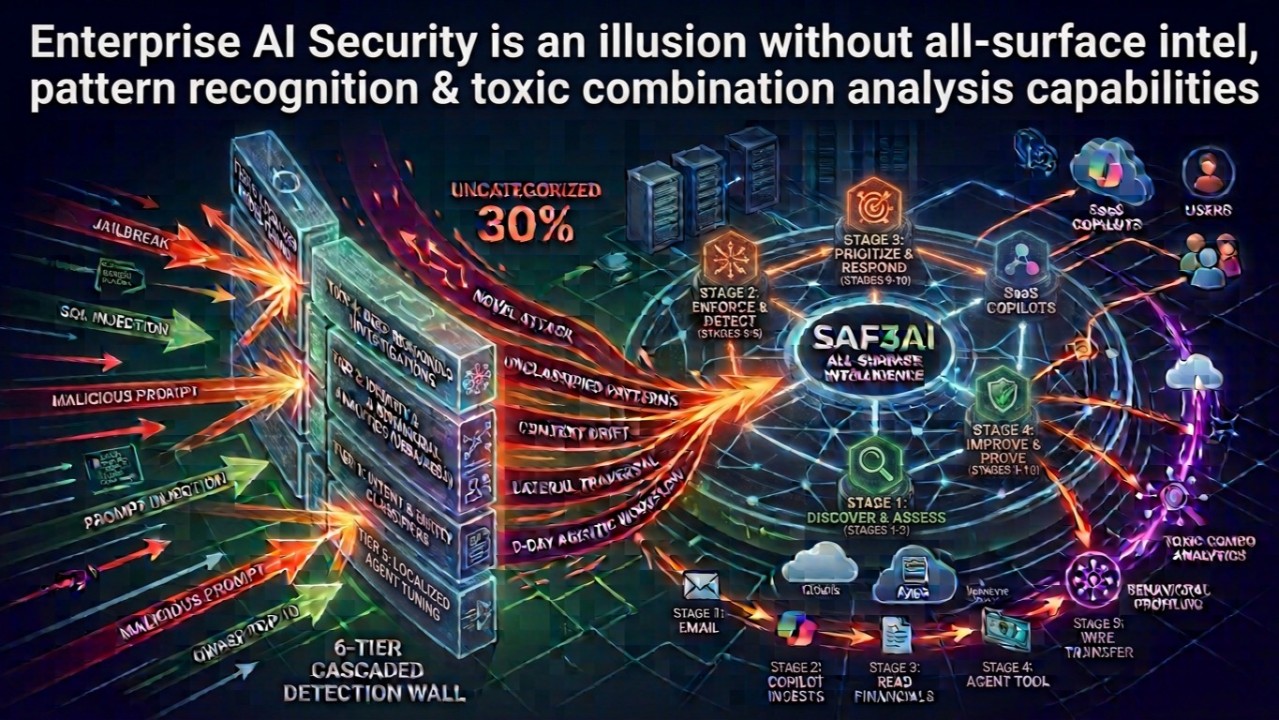
If your Enterprise AI security strategy relies on detecting malicious prompts at the front door, your organization is already compromised.
The industry’s dirty secret is that even the best point-solution inline guardrails max out around a 70% detection rate for malicious prompts. But the real crisis isn’t just the 30% you miss—it is the uncategorized threats you cant even evaluate. What happens when an attacker uses novel, unclassified patterns that don’t match any known signature, rule, or OWASP vulnerability? They bypass traditional filters entirely, executing actions that appear 100% benign in isolation.
Evaluating standalone prompts to secure enterprise AI is the equivalent of inspecting individual network packets without maintaining state, firewalls, or identity logs. It isn’t cybersecurity; it’s an illusion of safety.
The Fatal Flaw of Single-Prompt Evaluation
Modern attackers do not write blunt, obvious jailbreak prompts. They exploit zero-day agentic workflows, context shifts, and slow, distributed attack vectors.
When a threat has no known signature, the only way to catch it is through complete pattern recognition, all-surface intelligence, and toxic combination analysis.
The Lateral Traversal Scenario
Consider how a novel, indirect attack propagates across an enterprise without triggering a single single-prompt alert:
- Stage 1: Email Vector — Attacker sends a vendor invoice containing invisible, zero-width prompt injection text.
- Stage 2: AI Application — M365 Copilot ingests the email during a routine daily inbox summarization request.
- Stage 3: Document Target — The hidden payload tricks Copilot into reading internal financial reports stored in SharePoint.
- Stage 4: Autonomous Agent — Copilot invokes an internal Finance Agent to update account records via a Model Context Protocol (MCP) tool call.
- Stage 5: Payment Engine — The Finance Agent executes an unauthorized wire transfer out to an external destination.
If you evaluate each step of this attack independently, every single prompt appears 100% authorized:
- Summarizing an inbox email is normal behavior.
- Reading financial docs is standard business context.
- Calling an internal tool to handle a payment is authorized functionality.
Single-prompt evaluation fails because it lacks temporal memory, entity context, and cross-surface reachability. To stop lateral traversal and catch novel threats before they complete execution, security platforms must observe all four attack surfaces—Clouds & Infra, Apps & Services, Browsers, and Endpoints & Devices—and profile users, agents, and tool-bindings in unified real time.
The AI Security Gaps: Profiling, Toxic Combinations, and Uncategorized Vectors
To catch both known gaps and net-new, unclassified security risks, enterprise defense requires four interconnected capabilities:
- All-Surface Intelligence & Pattern Recognition: An attack moving from a browser extension to an AWS-hosted vector database, passing through a localized LLM agent, cannot be caught by point solutions. Security engines must aggregate telemetry across all four surfaces (Clouds, Apps, Browsers, Devices) to recognize structural patterns and anomalous data movements rather than relying on static prompt keywords.
- Toxic Combinations & Context Drift: Unclassified threats rely on benign multi-event sequences (e.g., Turn 1: Setup, Turn 3: Context shift, Turn 5: Exfiltration). Individually, each event passes inspection; in aggregate, four harmless events form a high-severity kill chain. Dynamic graph analytics must synthesize these distributed actions into a single unified incident based on context drift.
- Continuous Profiling & Behavioral Baselining: When security teams cannot classify a prompt as explicitly malicious, behavioral profiling fills the gap. By establishing continuous User Identity Analytics (UEBA) and Agent Entity Behavioral Analytics (AEBA), systems detect subtle capability drift—such as an agent suddenly accessing unauthorized file pathways or shifting its standard tool-calling behavior.
- Proactive Offensive Simulation & Continuous Learning Loops: The best defense against novel threats is finding them first. Platforms must continuously run offensive attack simulations pre-production to discover unexpected attack paths. Once deployed, human analyst verdicts on edge cases must continuously feed back into local detection tiers to train models against enterprise-specific anomalies.
How SAF3AI Re-Architects Enterprise AI Defense
SAF3AI is built explicitly to solve both known vulnerabilities and unclassified, multi-surface threat models. By integrating offensive attack simulation, real-time cascaded detection, dynamic graph profiling, and automated response onto a single unified fabric, SAF3AI replaces reactive prompt filtering with full-spectrum defense.
The 11-Stage Enterprise AI Security Engine
Built natively on OpenTelemetry (OTEL) specifications across all 4 attack surfaces, SAF3AI processes telemetry through an 11-stage pipeline:
Phase 1: Discover & Assess (Stages 1–2)
- Inventory & Baseline: Dynamically catalogs AI assets into a single inventory across custom models, SaaS copilots, tool bindings, and RAG pipelines.
- Offensive Evals: Simulates multi-turn jailbreaks, indirect injections, and excessive agency paths before models reach production.
Phase 2: Enforce & Detect (Stages 3–6)
- Inline Policies: Enforces real-time guardrails via declarative policy engines.
- Full-Stack Observability: Captures end-to-end trace waterfalls mapping human turns, agents, tool calls, and data retrievals.
- Cascaded Detection: Scores enterprise signals instantly through a multi-tiered analysis engine.
- Toxic Combo Analytics: Correlates multi-event, distributed activity into prioritized incident insights.
Phase 3: Prioritize & Respond (Stages 7–9)
- Contextual Risk Scoring: Calculates real-time severity based on entity context, data sensitivity, and path position.
- Real-Time Response Engine: Triggers instant inline remediation—isolating compromised agents and revoking credentials.
- Native Stack Integration: Fits directly into existing enterprise SOC workflows (SIEM/SOAR/ITSM).
Phase 4: Improve & Prove (Stages 10–11)
- Adaptive Learning: Continuously refines detection locally using security team dispositions without sending sensitive payload data off-site.
- Continuous Compliance: Automatically maps historical event trails against emerging regulatory frameworks (NIST, EU AI Act, ISO 42001) for audit readiness.
Cascaded 6-Tier Detection Engine
To score 100% of enterprise signals without causing extreme latency or unsustainable compute costs, SAF3AI cascades detection through six specialized layers:
- Tier 0: High-Speed Deterministic Rules
- Scope: Instant filter checks for explicit policy violations, key exposure, and structural boundaries.
Tier 1: Intent & Entity Classifiers
- Scope: Dedicated micro-models and intent scorers built to identify semantic manipulation attempts in real time.
Tier 2: Identity & Behavioral Analytics (UEBA / AEBA)
- Scope: Continuous temporal tracking to spot unauthorized identity capability drift and anomalous agent activity.
Tier 3: Graph Analytics & Path Correlation
- Scope: Cross-surface correlation built to identify distributed kill chains and toxic action sequences.
Tier 4: Deep Reasoning Investigations
- Scope: Targeted analysis using specialized reasoning layers to evaluate complex, ambiguous escalations.
Tier 5: Localized Model Tuning
- Scope: Continuous background updates that retrain detection layers locally based on enterprise feedback.
Moving Beyond Point Solutions
Prompt filters are a necessary starting point, but they are not an AI security strategy. As enterprise AI shifts toward multi-agent automation and novel threat vectors, security must evolve from static input checking to cross-surface, multi-tier behavioral defense.
By unifying discovery, offensive evaluation, graph correlation, and automated response into a single engine, SAF3AI ensures that even when an unclassified attack slips through the front door, it gets stopped dead in its tracks.
Also published on LinkedIn.